About this pathway
Background
Desflurane, enflurane, halothane, isoflurane, methoxyflurane, and sevoflurane are fluorinated inhaled anesthetics contraindicated in patients with variants in RYR1 and CACNA1S see CPIC guideline for volatile anesthetic agents and succinylcholine in the context of RYR1 or CACNA1S genotypes [Article:30499100]. These genes and variants are involved with the pharmacodynamics side effects of the drugs. Halothane, and to a lesser degree the other volatile anesthetics, have been associated with fatal hepatic necrosis [Article:18509326]. It is generally considered that the extent of metabolism correlates with the toxicity: halothane being the most extensively metabolized, then methoxyflurane > sevoflurane > enflurane > isoflurane > desflurane [Articles:8214760, 18509326].
Metabolism
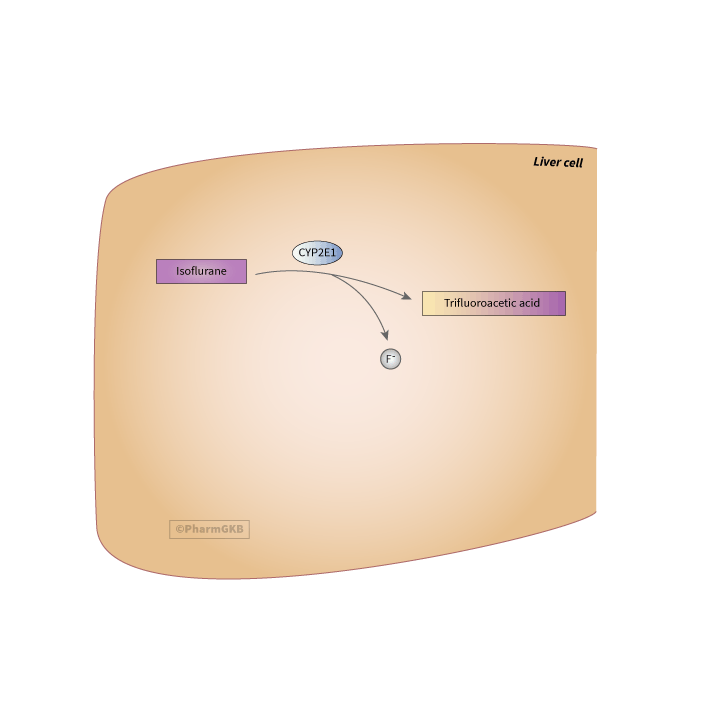
Isoflurane is minimally metabolized by CYP2E1 to trifluoroacetic acid (TFA). Only approximately 0.2% of isoflurane is metabolized [Article:25593732]. Isoflurane is considered less hepatotoxic compared to halothane and enflurane but some rare incidents of fatal hepatotoxicity have been reported [Article:25593732].
Reactions & interactions (2)
-
Biochemical Reaction
isoflurane → fluoride + trifluoroacetic acid
-
Catalysis
CYP2E1 → Biochemical Reaction
Edit history (2)
- 2021-07-02 Create
- 2024-06-28 Update fixed typo