About this pathway
Background
Oxcarbazepine is a second generation antiepileptic drug with similarities to carbamazepine but developed to be less metabolized by CYP enzymes and therefore considered less likely to have drug-drug interactions [Article:25063510]. However, similar to carbamezpine, there is an increased risk of severe cutaneous adverse reactions. The CPIC Dosing Guideline for oxcarbazepine recommends an alternative drug for oxcarbazepine-naive patients carrying at least one copy of HLA-B*15:02 due to the association of this allele with an increased risk of Stevens-Johnson syndrome (SJS) and toxic epidermal necrolysis (TEN). The FDA label states that oxcarbazepine should be avoided in patients positive for HLA-B*1502.
Metabolism
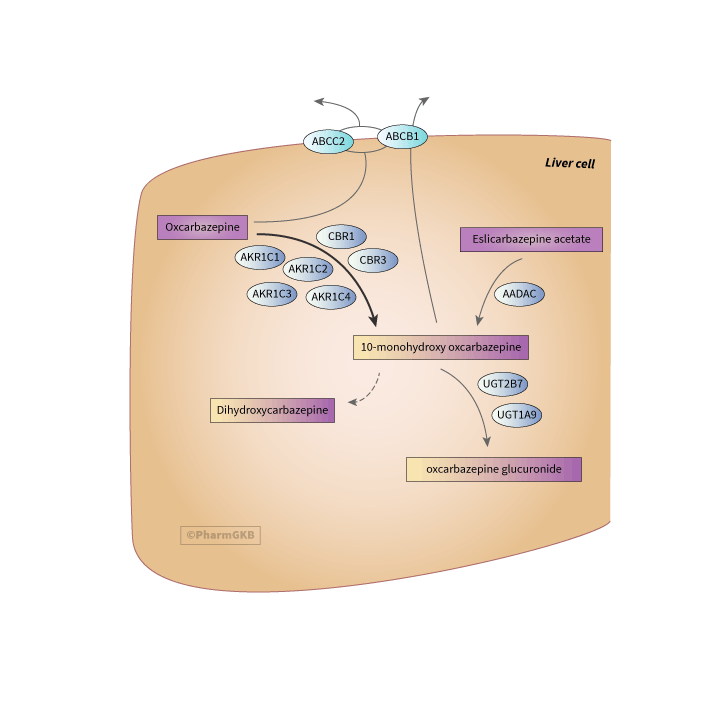
Oxcarbazepine is reduced by cytosolic reductases AKR1C1, AKR1C2, AKR1C3, AKR1C4, CBR1 and CBR3 to the active metabolite 10-monohydroxy oxcarbazepine also called liscarbazepine, monohydroxy derivative or MHD [Article:25063510]. MHD has two stereoisomers, AKR1C3, AKR1C4 preferentialy form R-MHD whereas AKR1C1, AKR1C2, CBR1 and CBR3 predominantly form S-MHD [Article:25063510].
A third generation antiepileptic and prodrug form of S-MHD, eslicarbazpine acetate is also depicted above [Article:32049739]. Eslicarbazpine acetate is metabolized by arylacetamide deacetylase, AADAC into MHD [Article:33446525].
The majority of MHD is glucuronidated and excreted into urine [Article:25063510]. A small proportion of MHD, less than 4% of parent drug, is oxidized to form the inactive dihydroxy derivative dihydroxycarbazepine (also called carbamazepine diol) [Article:25063510].
Transport
Oxcarbazepine and MHD are substrates of ABCB1 [Article:28528287]. Polymorphisms in ABCC2 are associated with oxcarbazepine dose suggesting it is also involved in oxcarbazepine transport [Article:25823783].
Reactions & interactions (18)
-
Biochemical Reaction
10-monohydroxy oxcarbazepine → dihydroxycarbazepine
-
Biochemical Reaction
eslicarbazepine → 10-monohydroxy oxcarbazepine
-
Biochemical Reaction
oxcarbazepine → 10-monohydroxy oxcarbazepine
-
Biochemical Reaction
10-monohydroxy oxcarbazepine → oxcarbazepine glucuronide
-
Catalysis
AADAC → Biochemical Reaction
-
Catalysis
ABCC2 → Transport
-
Catalysis
ABCB1 → Transport
-
Catalysis
AKR1C3 → Biochemical Reaction
-
Catalysis
CBR1 → Biochemical Reaction
-
Catalysis
CBR3 → Biochemical Reaction
-
Catalysis
AKR1C4 → Biochemical Reaction
-
Catalysis
AKR1C1 → Biochemical Reaction
-
Catalysis
AKR1C2 → Biochemical Reaction
-
Catalysis
ABCB1 → Transport
-
Catalysis
UGT2B7 → Biochemical Reaction
-
Catalysis
UGT1A9 → Biochemical Reaction
-
Transport
oxcarbazepine → oxcarbazepine
-
Transport
10-monohydroxy oxcarbazepine → 10-monohydroxy oxcarbazepine
Edit history (1)
- 2021-06-28 Create