About this pathway
Background
Meloxicam is a non-steroidal anti-inflammatory drug (NSAID) approved for osteoarthritis and rheumatoid arthritis in adults, and juvenile rheumatoid arthritis. The FDA label discusses CYP2C9 poor metabolizers and the table suggests to "Consider dose reductions in poor metabolizers. Monitor patients for adverse reactions."
The CPIC Dosing Guideline for meloxicam recommends alternative therapy for CYP2C9 poor metabolizers due to markedly prolonged half-life, and initiating therapy with 50% of the lowest recommended starting dose or choose an alternative therapy for CYP2C9 intermediate metabolizers with activity score of 1. See full guideline for further details and supporting evidence.
Metabolism
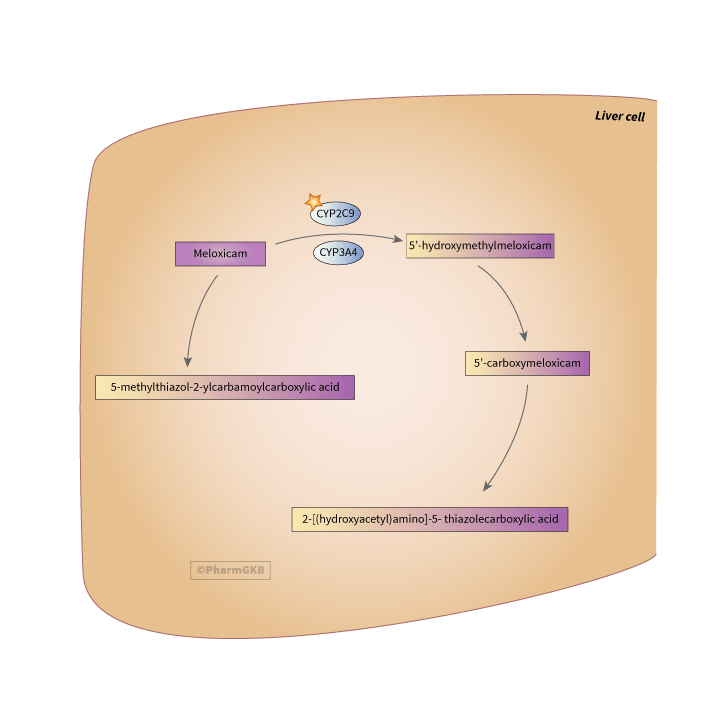
Meloxicam is extensively metabolized to four metabolites found in urine [Article:10092958]. The 5'-hydroxy metabolite is formed mostly by CYP2C9 with a minor contribution from CYP3A4 [Articles:9493314, 10381752]. This is further metabolized to the carboxy metabolite in a reaction that does not involve cytochrome P450 enzymes [Article:9493314].
Reactions & interactions (6)
-
Biochemical Reaction
meloxicam → 5-methylthiazol-2-ylcarbamoylcarboxylic acid
-
Biochemical Reaction
5'-carboxymeloxicam → 2-[(hydroxyacetyl)amino]-5- thiazolecarboxylic acid
-
Biochemical Reaction
5'-hydroxymeloxicam → 5'-carboxymeloxicam
-
Biochemical Reaction
meloxicam → 5'-hydroxymeloxicam
-
Catalysis
CYP2C9 → Biochemical Reaction
-
Catalysis
CYP3A4 → Biochemical Reaction
Edit history (1)
- 2021-06-10 Create