About this pathway
Background
Trimipramine is a tricyclic antidepressant (TCA) used in the treatment of depression. TCAs are mixed serotonin and norepinephrine reuptake inhibitors which can be classified by their chemical structure into tertiary amines and secondary amines. Trimipramine is a tertiary amine. Tertiary amines have a greater serotonergic effect in the body, while secondary amines have a greater noradrenergic effect [Article:17471183].
Metabolism
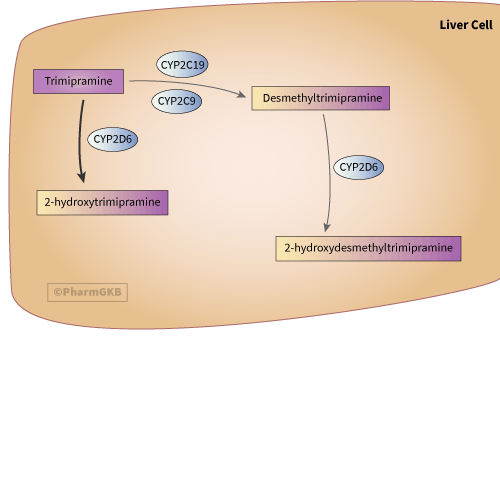
Trimipramine is metabolized in the liver to the secondary amine desmethyltrimipramine, which is also pharmacologically active. This metabolism is predominantly carried by CYP2C19 [Articles:2778096, 6527248, 10774635], with CYP2C9 playing a minor role [Article:14520122].
Both trimipramine and desmethyltrimipramine are hydroxylated by CYP2D6 to form 2-hydroxytrimipramine and 2-hydroxydesmethyltrimipramine, respectively [Articles:14646691, 14520122, 10774635, 6527248, 1454163, 8204992]. This hydroxylation step inactivates trimipramine and desmethyltrimipramine.
Metabolism of trimipramine has been found to be affected by different CYP2D6 and CYP2C19 phenotypes [Articles:14646691, 14520122]. Pharmacogenetic dosing recommendations for CYP2D6, CYP2C19 and trimipramine can be found as part of the CPIC guideline for tricyclic antidepressants [Article:27997040].
Reactions & interactions (7)
-
Biochemical Reaction
trimipramine → desmethyltrimipramine
-
Biochemical Reaction
desmethyltrimipramine → 2-hydroxydesmethyltrimipramine
-
Biochemical Reaction
trimipramine → 2-hydroxytrimipramine
-
Catalysis
CYP2C19 → Biochemical Reaction
-
Catalysis
CYP2C9 → Biochemical Reaction
-
Catalysis
CYP2D6 → Biochemical Reaction
-
Catalysis
CYP2D6 → Biochemical Reaction
Edit history (1)
- 2021-05-27 Create