About this pathway
Background
Desflurane, enflurane, halothane, isoflurane, methoxyflurane, and sevoflurane are fluorinated inhaled anesthetics contraindicated in patients with variants in RYR1 and CACNA1S see CPIC guideline for volatile anesthetic agents and succinylcholine in the context of RYR1 or CACNA1S genotypes [Article:30499100]. These genes and variants are involved with the pharmacodynamics side effects of the drugs. Halothane, and to a lesser degree the other volatile anesthetics, have been associated with fatal hepatic necrosis [Article:18509326]. It is generally considered that the extent of metabolism correlates with the toxicity: halothane being the most extensively metabolized, then methoxyflurane > sevoflurane > enflurane > isoflurane > desflurane [Article:8214760].
Metabolism
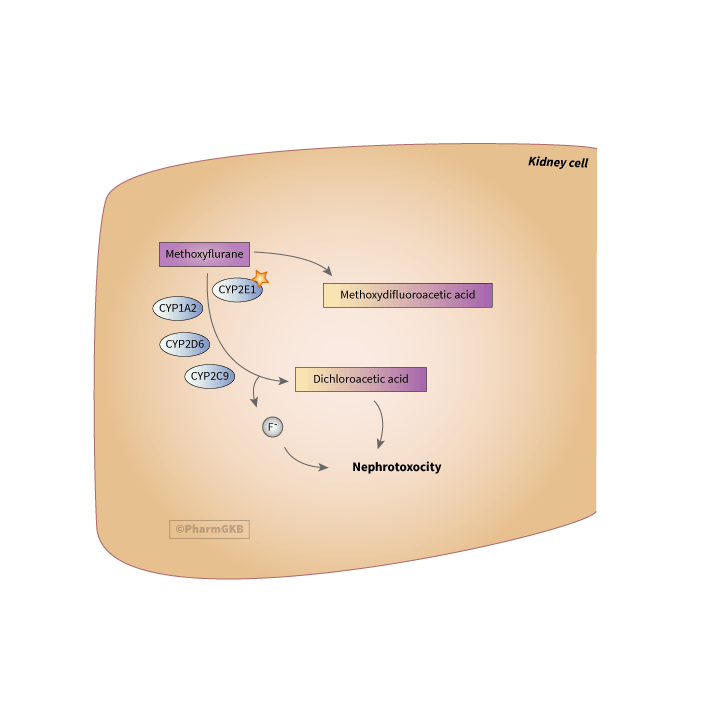
Methoxyflurane can be metabolized by two routes - dechlorination to methoxydifluoroacetic acid or demethylation to form dichloroacetatic acid [Article:17006072]. The use of methoxyflurane has been limited because of its nephrotoxicity[Article:17006073]. Originally it was thought that excess fluoride ion was the main agent of nephrotoxicity although other anesthetics release similar amounts of fluoride ions with less toxicity [Article:17006073]. Kharash et el suggest that it is the combination of dichloroacetatic acid and fluoride ions that results in increased nephrotoxicity [Articles:17006072, 17006073].
Reactions & interactions (8)
-
Biochemical Reaction
methoxyflurane → methoxydifluoroacetic acid
-
Biochemical Reaction
methoxyflurane → dichloroacetic acid + fluoride
-
Catalysis
CYP2E1 → Biochemical Reaction
-
Catalysis
CYP1A2 → Biochemical Reaction
-
Catalysis
CYP2D6 → Biochemical Reaction
-
Catalysis
CYP2C9 → Biochemical Reaction
-
Leads To
dichloroacetic acid → nephrotoxicity
-
Leads To
fluoride → nephrotoxicity
Edit history (2)
- 2021-03-25 Create
- 2021-06-23 Update Updated text to include more on nephrotoxicity.