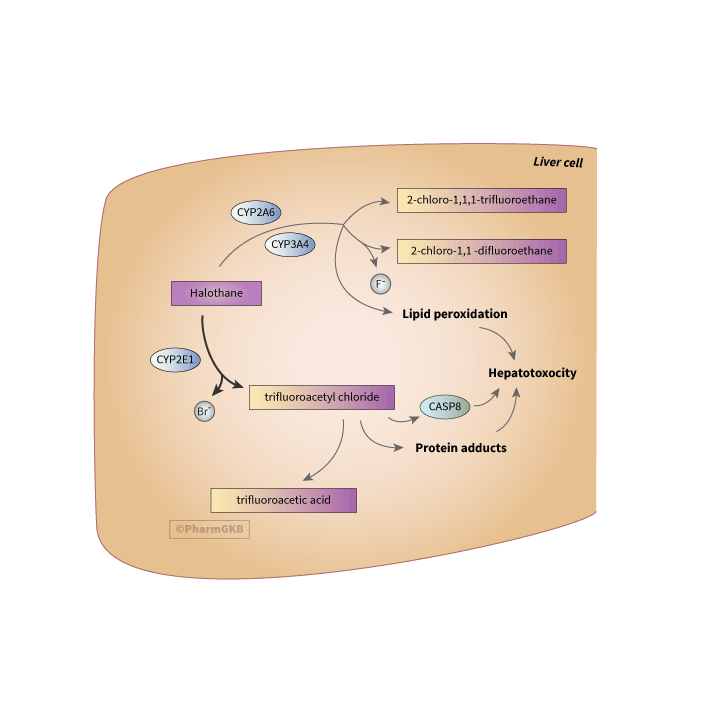
About this pathway
Background
Desflurane, enflurane, halothane, isoflurane, methoxyflurane, and sevoflurane are fluorinated inhaled anesthetics contraindicated in patients with variants in RYR1 and CACNA1S see CPIC guideline for volatile anesthetic agents and succinylcholine in the context of RYR1 or CACNA1S genotypes [Article:30499100]. These genes and variants are involved with the pharmacodynamics side effects of the drugs. Halothane, and to a lesser degree the other volatile anesthetics, have been associated with fatal hepatic necrosis [Article:18509326]. It is generally considered that the extent of metabolism correlates with the toxicity: halothane being the most extensively metabolized, then methoxyflurane > sevoflurane > enflurane > isoflurane > desflurane [Article:8214760].
Metabolism
Halothane was the first fluorinated inhaled anesthetic of the class and has been associated with the most toxicity problems [Articles:337973, 8214760]. Approximately 20-50% of the drug is metabolized with the remainder eliminated unchanged [Article:18509326]. There are two principle pathways for metabolism: oxidative and reductive. Under normal conditions, the majority of halothane is metabolized through the oxidative pathway catalyzed mostly by CYP2E1 [Article:9103523]. Less than 1% is metabolized through the reductive pathway [Article:22087107] Human reductive halothane metabolism in vitro can be catalyzed by CYP2A6 and CYP3A4 [Article:8886607].
Reactions & interactions (12)
-
Activation
trifluoroacetyl chloride → CASP8
-
Biochemical Reaction
halothane → bromide + trifluoroacetyl chloride
-
Biochemical Reaction
halothane → 2-chloro-1,1-difluoroethene + fluoride
-
Biochemical Reaction
halothane → 2-chloro-1,1,1-trifluoroethane
-
Biochemical Reaction
trifluoroacetyl chloride → trifluoroacetic acid
-
Catalysis
CYP2E1 → Biochemical Reaction
-
Catalysis
CYP3A4 → Biochemical Reaction
-
Catalysis
CYP2A6 → Biochemical Reaction
-
Catalysis
CYP2A6 → Biochemical Reaction
-
Catalysis
CYP3A4 → Biochemical Reaction
-
Leads To
trifluoroacetyl chloride → Toxic liver disease
-
Leads To
CASP8 → Toxic liver disease
Edit history (1)
- 2021-03-18 Create