About this pathway
Background
Proton pump inhibitors (PPIs) are a class of drugs that block the acid secretion from parietal cells in the stomach, thereby providing relief from acid-related disorders (see Proton Pump Inhibitor Pathway, Pharmacodynamics ). Different drugs within the class are prescribed for different patient groups with esomeprazole and lansoprazole for pediatric erosive esophagitis and esomeprazole for infant and pediatric GERD [Article:23512128]. Although PPIs are active in the stomach, they are primarily metabolized in the liver by CPY2C19 and CYP3A4. CYP2C19 genotypes have been linked to PPI exposure, with lower exposure associated with treatment failure. There is a CPIC Dosing Guideline for omeprazole, lansoprazole, pantoprazole based on CYP2C19 genotypes.
Metabolism
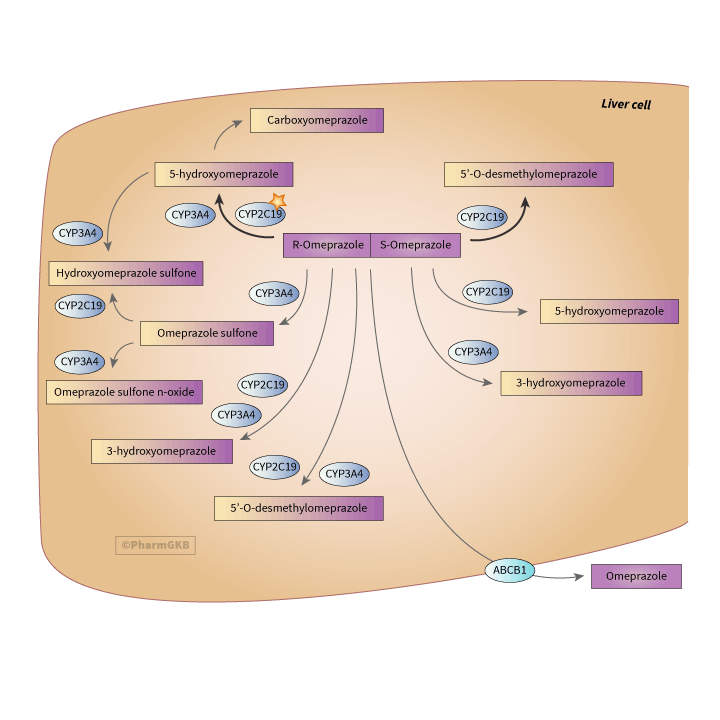
Omeprazole is a mixture of two stereoisomers R-omeprazole and S-omeprazole. S-omeprazole or esomeprazole, is also marketed independently as a drug [Article:10886041]. The metabolism of omeprazole is stereoselective. The rate of metabolism of the S enantiomer is lower and less variable than that of the R enantiomer resulting in higher plasma concentrations of S-omeprazole following administration of a racemic mixture of equal amounts [Article:11475467].
The main metabolites of omeprazole in vitro are 5-hydroxyomeprazole, omeprazole sulfone, 5'O-desmethylomeprazole, and to a lesser degree, 3-hydroxyomeprazole [Articles:16093273, 31846760]. The primary route of metabolism for R-omeprazole is the conversion to 5-hydroxyomeprazole by CYP2C19 with some contribution of CYP3A4 [Article:16093273]. S-omeprazole is converted primarily to 5'O-desmethylomeprazole via CYP2C19 [Articles:16093273, 31846760]. CYP3A4 converts S-omeprazole to 3-hydroxyomeprazole [Article:16093273].
Transport
Omeprazole is a substrate for ABCB1 [Article:11770010]. A couple of studies suggest ABCB1 variation may play a role in omeprazole pharmacokinetics or outcomes but further studies are needed [Articles:29377228, 15976989].
Reactions & interactions (27)
-
Biochemical Reaction
5-hydroxyomeprazole → carboxyomeprazole
-
Biochemical Reaction
omeprazole sulfone → hydroxyomeprazole sulfone
-
Biochemical Reaction
esomeprazole → 3-hydroxyomeprazole
-
Biochemical Reaction
omeprazole sulfone → omeprazole sulfone n-oxide
-
Biochemical Reaction
5-hydroxyomeprazole → hydroxyomeprazole sulfone
-
Biochemical Reaction
esomeprazole → 5-hydroxyomeprazole
-
Biochemical Reaction
r-omeprazole → 5-hydroxyomeprazole
-
Biochemical Reaction
r-omeprazole → omeprazole sulfone
-
Biochemical Reaction
esomeprazole → 5'o-desmethylomeprazole
-
Biochemical Reaction
r-omeprazole → 3-hydroxyomeprazole
-
Biochemical Reaction
r-omeprazole → 5'o-desmethylomeprazole
-
Catalysis
CYP2C19 → Biochemical Reaction
-
Catalysis
CYP3A4 → Biochemical Reaction
-
Catalysis
CYP3A4 → Biochemical Reaction
-
Catalysis
CYP3A4 → Biochemical Reaction
-
Catalysis
CYP2C19 → Biochemical Reaction
-
Catalysis
ABCB1 → Transport
-
Catalysis
CYP2C19 → Biochemical Reaction
-
Catalysis
CYP3A4 → Biochemical Reaction
-
Catalysis
CYP3A4 → Biochemical Reaction
-
Catalysis
CYP2C19 → Biochemical Reaction
-
Catalysis
CYP3A4 → Biochemical Reaction
-
Catalysis
CYP2C19 → Biochemical Reaction
-
Catalysis
CYP3A4 → Biochemical Reaction
-
Leads To
omeprazole → esomeprazole
-
Leads To
omeprazole → r-omeprazole
-
Transport
omeprazole → omeprazole
Edit history (4)
- 2007-08-08 Create
- 2021-04-12 Update New gpml to better describe relationships between enantiomers of omeprazole and which metabolites are generated.
- 2021-04-14 Update Updated gpml and figure.
- 2021-04-28 Update Updated text to add in references and links to guideline.