About this pathway
Background
Proton pump inhibitors (PPIs) are a class of drugs that block the acid secretion from parietal cells in the stomach, thereby providing relief from acid-related disorders (see Proton Pump Inhibitor Pathway, Pharmacodynamics ). Different drugs within the class are prescribed for different patient groups with esomeprazole and lansoprazole for pediatric erosive esophagitis and esomeprazole for infant and pediatric GERD [Article:23512128]. Although PPIs are active in the stomach, they are primarily metabolized in the liver by CPY2C19 and CYP3A4. CYP2C19 genotypes have been linked to PPI exposure, with lower exposure associated with treatment failure. There is a CPIC Dosing Guideline for omeprazole, lansoprazole, pantoprazole based on CYP2C19 genotypes.
Metabolism
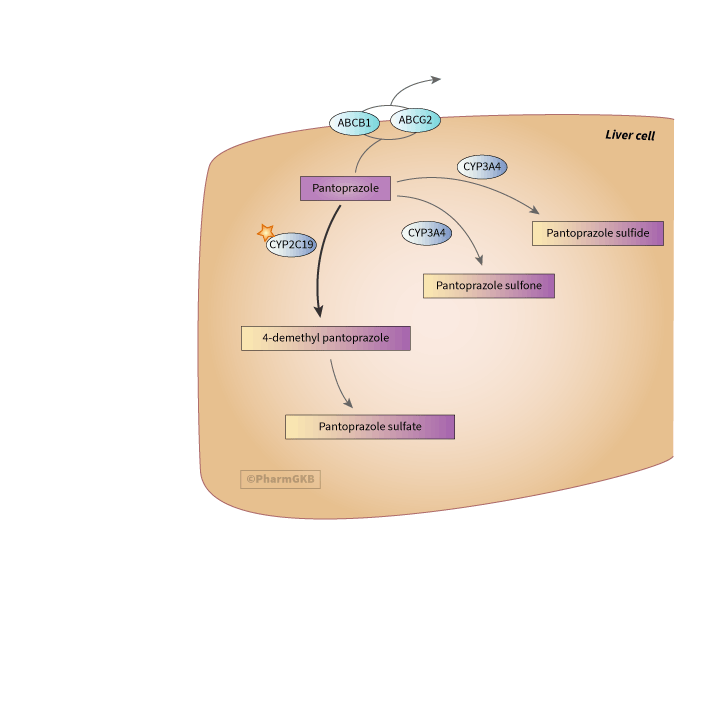
There is not a clear consensus in the literature regarding the details of pantoprazole metabolism. The FDA drug label describes it thus: “The main metabolic pathway is demethylation, by CYP2C19, with subsequent sulfation; other metabolic pathways include oxidation by CYP3A4”. Sugimoto and Furuta depict demethylation followed by sulfotransferase to form pantoprazole sulfate [Article:22649281]. The figure above shows demethylation to the 4-demethlypantoprazole metabolite since a structure was available from PubChem. There are other resources that show 5-hydroxypantoprazole as the product formed by CYP2C19 and then an unnamed sulfotransferase acts to produce pantoprazole sulfate [Articles:23512128, 31846760]. This is more consistent with other PPIs such as omeprazole and lansoprazole which are also metabolized by CYP2C19 to a 5-hydroxy metabolite, however there is no structure in PubChem defining a 5-hydroxy pantoprazole metabolite. All proposed pathways in the literature agree on formation of pantoprazole sulfone via CYP3A4 [Articles:23512128, 31846760, 22649281] and some depict formation of pantoprazole sulfide as another product of CYP3A4 metabolism [Articles:23512128, 31846760].
Transport
Pantoprazole is a substrate for ABCB1 and ABCG2 [Articles:22355035, 15976989, 20376628, 18823430, 27611887]. Some studies have examined the role of ABCB1 variants in the efficacy of Helicobacter pylori eradication but the majority were not significant [Articles:15976989, 20376628, 18823430, 27611887].
Reactions & interactions (10)
-
Biochemical Reaction
pantoprazole → pantoprazole sulfone
-
Biochemical Reaction
4-demethyl pantoprazole → pantoprazole sulfate
-
Biochemical Reaction
pantoprazole → pantoprazole sulfide
-
Biochemical Reaction
pantoprazole → 4-demethyl pantoprazole
-
Catalysis
CYP3A4 → Biochemical Reaction
-
Catalysis
ABCG2 → Transport
-
Catalysis
ABCB1 → Transport
-
Catalysis
CYP3A4 → Biochemical Reaction
-
Catalysis
CYP2C19 → Biochemical Reaction
-
Transport
pantoprazole → pantoprazole
Edit history (2)
- 2020-10-20 Create
- 2024-06-13 Update fixed typo