About this pathway
Background
Allopurinol is a purine analogue that has been first line treatment for gout since the 1960s [Article:27798228]. It is also approved for uric acid reduction and prevention/treatment of tumor lysis syndrome in cancer patients [Article:32158483]. Severe adverse drug reactions (SCAR) have been experienced in patients treated with allopurinol and are associated with a variant of HLA-B see CPIC guidelines for Allopurinol and HLA-B. The different types of SCARs range in severity from rash to death. High levels of oxypurinol are associated with poor outcomes in patients with allopurinol-induced SCAR including high mortality of allopurinol-SJS/TEN [Article:25115449]. Allopurinol hypersensitivity was shown to be mediated primarily by an oxypurinol-specific T-cell response [Article:26416594]. Therefore the pharmacokinetic pathways that determine relative oxypurinol concentrations, and the genes involved, may be important modifiers of severity of adverse reactions.
Metabolism
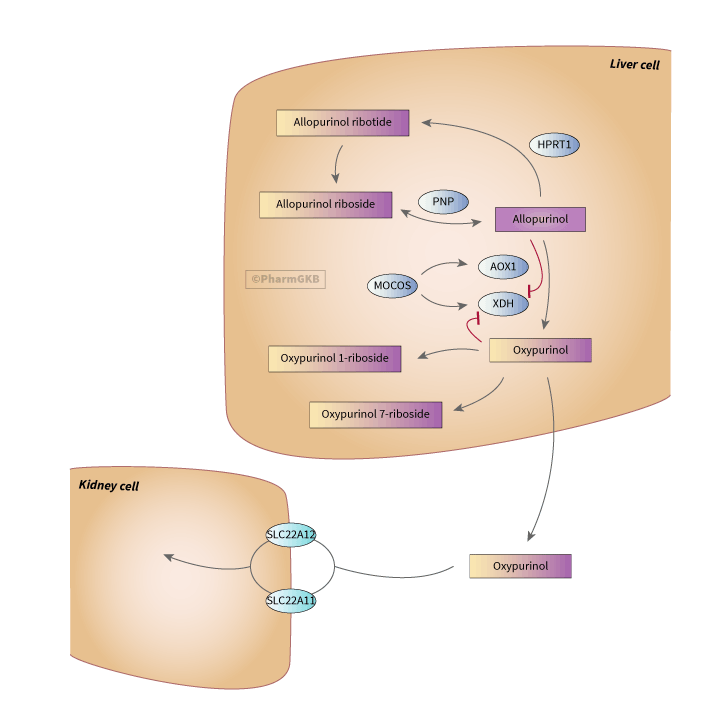
Allopurinol is converted to oxypurinol via endogenous pathways that normally function for the purines hypoxanthine and xanthine. In human liver this reaction is primarily carried out by aldehyde oxidase (AOX1) [Articles:24925693, 2323062]. It can also be catalyzed by xanthine oxidase, also called xanthine dehydrogenase or XDH [Articles:24925693, 2323062]. Both AOX1 and XDH require a molybdenum cofactor. Activation of the cofactor from the oxo-form to the sulfide form is carried out by MOCOS [Article:24925693].
Other pathways that function for modification of purines can also act on allopurinol such as HPRT1, that leads to allopurinol ribotide [Article:6409116] or PNP that can convert allopurinol to allopurinol riboside [Article:6409116]. Similarly metabolites of oxypurinol, oxypurinol-1-riboside and oxypurinol-7-riboside, can be formed although the enzymes involved are not reported [Article:17655371].
Oxypurinol is excreted by the kidneys. Transporters lead to uptake of oxypurinol into the kidneys [Article:16135657]. There are known functional variants of transporters SLC22A11 [Article:20668102] and SLC22A12 [Article:31591475].
Reactions & interactions (18)
-
Activation
MOCOS → XDH
-
Activation
MOCOS → AOX1
-
Biochemical Reaction
oxypurinol → oxypurinol 1-riboside
-
Biochemical Reaction
allopurinol → oxypurinol
-
Biochemical Reaction
allopurinol ribotide → allopurinol riboside
-
Biochemical Reaction
allopurinol → allopurinol ribotide
-
Biochemical Reaction
oxypurinol → oxypurinol 7-riboside
-
Biochemical Reaction
allopurinol riboside → allopurinol
-
Catalysis
AOX1 → Biochemical Reaction
-
Catalysis
XDH → Biochemical Reaction
-
Catalysis
HPRT1 → Biochemical Reaction
-
Catalysis
PNP → Biochemical Reaction
-
Catalysis
SLC22A12 → Transport
-
Catalysis
SLC22A11 → Transport
-
Inhibition
oxypurinol → XDH
-
Inhibition
allopurinol → XDH
-
Transport
oxypurinol → oxypurinol
-
Transport
oxypurinol → oxypurinol
Edit history (2)
- 2020-06-04 Create
- 2021-02-19 Update Added text description.