About this pathway
Propranolol Pathway, Pharmacokinetics
Background
Propranolol is a beta-blocker which is used for treatment of various conditions including hypertension, angina pectoris and migraine and pediatric hemangioma. Propranolol obtained FDA approval for the treatment of Infantile hemangiomas in March 2014. Infantile hemangiomas are the most common benign tumor of infancy with an incidence of approximately 4–5% [Article:29388636]. As with other beta-blockers the drug is given as a racemic mixture and there are differences in enantiomer pharmacokinetics and pharmacodynamics [Article:16763014].
Metabolism
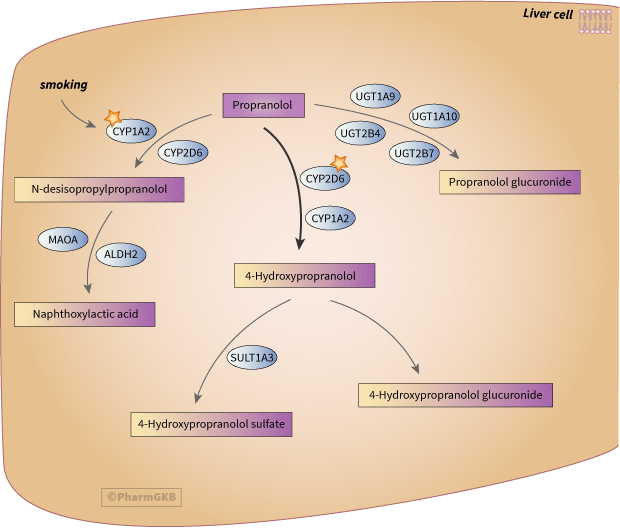
Propranolol is initially metabolized by three main pathways: ring oxidation (approximately 33% of dose), side chain oxidation (20%) and glucuronidation (17%)[Article:18936551][Article:9399616].
Side chain oxidation is a two step process. The first step to n-desisopropylpropranolol is catalyzed mainly by CYP1A2 with some involvement of CYP2D6 [Article:9399616]. The second step results in napthoxylactic acid [Article:2776391][Article:7895609][Article:9399616]. Candidate genes for the second step were suggested from experiments with rat liver microsomes, and include monoamine oxidase (MAOA) and mitochondrial aldehyde dehydrogenase (ALDH2) [Article:12269395].
Ring oxidation to 4-hydroxypropranolol is primarily catalyzed by CYP2D6 [Article:7895609][Article:9399616]. There is some residual catalysis to 4-hydroxypropranolol in the presence of CYP2D6 inhibitor quinidine, likely occurring via CYP1A2 [Article:10945865]. Healthy individuals with poor metabolizer (PM) CYP2D6 phenotype status (as measured by debrisoquine) showed no significant difference in blood concentrations of propranolol nor propranolol response as measured by exercise heart rate compared to extensive metabolizers (EMs)[Article:9399616]. However, flux through the pathway did change with CYP2D6 PMs having increased clearance of napthoxylactic acid and decreased 4-hydroxypropanolol compared to EMs [Article:9399616].
Glucuronidation of propranolol is carried out by UGT1A9, UGT2B4 and UGT2B7 in the liver and UGT1A10 extrahepatically [Article:18936551][Article:16763014]. There was some steroisoform specificity with the S enantiomer glucuronidated faster than the R enantiomer [Article:16763014].
Secondary metabolism of 4-hydroxypropranolol occurs by glucuronidation and sulfation. SULT1A3 is involved in the sulfation of 4-hydroxypropranolol [Article:15748705]. The enzymes responsible for the glucuronidation of 4-hydroxypropranolol specifically (as opposed to gluruonidation of the parent drug) are not reported.
Reactions & interactions (18)
-
Activation
Tobacco Use Disorder → CYP1A2
-
Biochemical Reaction
propranolol → n-desisopropylpropranolol
-
Biochemical Reaction
propranolol → propranolol glucuronide
-
Biochemical Reaction
propranolol → 4-hydroxypropranolol
-
Biochemical Reaction
4-hydroxypropranolol → 4-hydroxypropranolol glucuronide
-
Biochemical Reaction
4-hydroxypropranolol → 4-hydroxypropranolol sulfate
-
Biochemical Reaction
n-desisopropylpropranolol → naphthoxylactic acid
-
Catalysis
CYP1A2 → Biochemical Reaction
-
Catalysis
CYP2D6 → Biochemical Reaction
-
Catalysis
UGT1A9 → Biochemical Reaction
-
Catalysis
UGT1A10 → Biochemical Reaction
-
Catalysis
UGT2B7 → Biochemical Reaction
-
Catalysis
UGT2B4 → Biochemical Reaction
-
Catalysis
CYP1A2 → Biochemical Reaction
-
Catalysis
CYP2D6 → Biochemical Reaction
-
Catalysis
SULT1A3 → Biochemical Reaction
-
Catalysis
MAOA → Biochemical Reaction
-
Catalysis
ALDH2 → Biochemical Reaction
Edit history (1)
- 2019-07-16 Create