About this pathway
Methylphenidate (MPH), used for the treatment of attention deficit hyperactivity disorder (ADHD) and narcolepsy, is a central nervous system (CNS) stimulant with a mechanism of action that prevents the reuptake of dopamine and norepinephrine through inhibition of the dopamine (SLC6A3) and norepinephrine (SLC6A2) transporters. MPH is primarily metabolized by carboxylesterase 1 (CES1) however there are multiple factors affecting the pharmacodynamics of MPH.
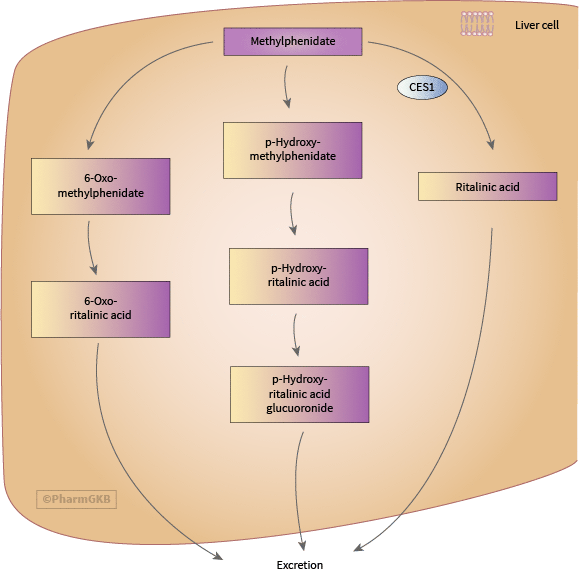
The primary metabolic pathway of MPH involves carboxylesterase 1 (CES1), primarily expressed in the liver [Article:15082749]. CES1 mediates de-esterification of MPH to the inactive metabolite aphenyl-2-piperidine acetic acid, more commonly known as ritalinic acid (RA). This de-esterification heavily favors the stereoselective hydrolysis of l-MPH [Article:15082749], resulting in d-MPH as the primary isomer found in plasma [Article:14594346]. Further, only d-methylphenidate has been shown to exhibit significant pharmacological activity, with no metabolic conversion between d- and l-MPH [Article:1424430]. Most formulations of MPH contain a racemic mixture of d- and l-MPH, although there are formulations available of dexmethylphenidate (d-MPH) alone. While CES1 is closely related to carboxylesterase 2 (CES2) [Articles:11950776, 16837570], MPH is metabolized solely by CES1 [Article:15082749].
In several single dose pharmacokinetic studies, 60-80% of administered doses were recovered as RA in human urine after 48 hours ([Articles:4473537, 2079507, 2395090], Bartlett and Egger 1972). Microsomal oxidation and aromatic hydroxylation of MPH in humans also produce the inactive metabolites 6-oxo-methylphenidate (6-oxo-MPH) and p-hydroxy-methylphenidate (p-hydroxy-MPH) respectively [Article:4473537]. The metabolite p-hydroxy-MPH has been shown to exhibit pharmacological activity in mice; however, this has not been studied in humans [Article:7328584]. The metabolite 6-oxo-MPH is converted to 6-oxo-ritalinic acid via de-esterification, with the sum of these 6-oxo- metabolites accounting for up to 1.5% of the total dose [Article:4473537]. This is less that what was previously reported by Bartlett and Egger, who reported 6-oxo-ritalinic acid accounting for 5 to 12% of the administered dose (Bartlett and Egger 1972). Similarly, p-hydroxy-MPH is metabolized by de-esterification to p-hydroxy-ritalinic acid and subsequently glucuronidated to p-hydroxy-ritalinic acid glucuronide and accounts for up to 2.5% of the total dose of MPH [Article:4473537]. These downstream metabolites of 6-oxo-MPH and p-hydroxy-MPH are also inactive [Article:4473537]. Fecal excretion of MPH and its metabolites account for up to 3% of the total dose, while less than 2% of the total dose is excreted unchanged in the urine ([Article:4473537], Bartlett and Egger 1972]). It was previously hypothesized that MPH was metabolized by CYP2D6 due to the observed activity at inhibiting CYP2D6 substrates (Perel et al. 1969, Hunninghake 1970); however, this hypothesis was not supported in a pharmacokinetic study in humans with and without quinidine (a potent CYP2D6 inhibitor) [Article:10831022].
An additional transesterification metabolite (l-ethylphenidate) is formed when methylphenidate is taken concomitantly with ethanol [Article:10440465]. In an open, 3-way randomized crossover study, subjects were administered standardized doses of MPH with and without ethanol. The AUC values of MPH were significantly higher when ethanol was administered 30 minutes before and after MPH (105.2 and 102.8 ng*hr/ml (P < 0.0001)) as compared to no ethanol administration (82.9 ng*hr/ml). Cmax values of d-MPH were similarly increased upon ethanol administration (21.5 and 21.4 ng/ml (P < 0.0001)) before and after MPH as compared to without ethanol (15.3 ng/ml). The results of this study demonstrate increased exposure to MPH and the pharmacologically active compound ethylphenidate, raising concerns about the abuse potential when ingested with ethanol [Article:17339864].
Pharmacogenomic studies of CES1 are complicated by the inactive truncated pseudogene CES1P1, also referred to as CES1A3, located near CES1 on chromosome 16. The ‘wild-type’ haplotype of CES1 consists of CES1 (also referred to as CES1A1) and the inactive CES1P1. Hypothesized to have been created through gene exchange events, CES1P1 can form hybrid genes with CES1 which can have increased transcriptional activity relative to CES1P1 [Article:28786738]. Additionally, CES1 and CES1P1 can form the hybrid gene variant CES1A2, which has 2% of the transcriptional efficiency of CES1 [Article:18794728]. Other identified hybrid variants include CES1A1b and CES1A1c, also known as CES1VAR [Article:28786738]. Multiple haplotypes and diplotypes exist with these various CES1 variants, and individuals can carry more than two active copies of CES1 (i.e. two CES1 copies and one CES1A2 copy for a copy number of three or two CES1 copies and two CES1A2 copies for a copy number of four) [Articles:28786738, 28087982].
Pharmacokinetic/pharmacogenetic studies of MPH and CES1 have focused on rs71647871, commonly referred by the amino acid substitution G143E. An individual heterozygous for the G143E variant and a rare Asp260fs frameshift variant resulting in a premature stop codon was compared to 19 individuals without these variants. The AUC, Cmax and t1/2 of the individuals without the noted variants were 78.6 ng/ml* hrs, 13.8 ng/ml, and 3.0 hrs, respectively, while the same values for the individual with the two variants were 208.7 ng/ml*hrs, 36 ng/ml and 5.4 hrs (p < 0.01 for all parameters) [Article:18485328]. In a separate 30-day, prospective study of 122 children with ADHD providers titrated the dose of MPH between 10-30 mg in two doses to achieve adequate medication response. Subjects were then classified as responders or non-responders based on the ADHD Rating Scale assessment. There was no difference in response rate when comparing individuals with the G143E variant to those without the variant; however, amongst responders, those that were heterozygous for the G143E variant (n = 5) required significantly lower doses (0.41 mg/kg/day vs. 0.57 mg/kg/day; p = 0.022) of MPH than those without the variant (n = 85) [Article:19733552]. This decreased dosing requirement in G143E variants supports decreased metabolic conversion of MPH to the inactive RA. This was further supported by a single-dose pharmacokinetic study (n = 44) in which G143E carriers had a 149% increase in AUC as compared to the control subjects (P < 0.0001). Notably, individuals with 4 copies of CES1 had 45% (P = 0.011) and 61% (P = 0.028) increased AUCs of d-methylphenidate as compared to control participants and those with 3 copies of CES1. With increased copy number, it would be expected that there would be increased CES1 activity, and therefore increased metabolism of MPH resulting in smaller AUCs; however, due to the inability to sequence past exon 5 in this study attributed to difficulties sequencing CES1 gene duplications, it is hypothesized that the decreased metabolic activity observed in these individuals may be due to polymorphisms downstream of exon 5 [Article:28087982].
As a CNS stimulant crossing the blood-brain barrier, the role of MPH as a substrate for the efflux transporter p-glycoprotein (P-gp) (encoded by ABCB1) has also been examined. A study in mice found that P-gp knockout mice had 33% higher brain concentrations of d-MPH (p < 0.05) than wild-type control mice 10 minutes after dosing but not at other measured time intervals past 10 minutes, suggesting d-MPH is a weak P-gp substrate [Article:16621932]. A follow-up in vitro study in porcine kidney epithelial cells found that the potent P-gp inhibitor PSC833 did not significantly alter d-MPH levels, supporting the previous study that d-MPH is a minor substrate of P-gp [Article:17963743]. Lastly, a clinical, open-label dose titration trial of MPH-naive Korean subjects administered MPH extended release for 4 weeks found that of 134 sequenced subjects, individuals homozygous for the ABCB1 c.2677G>T (rs2032582) variant were at an increased risk for experiencing adverse drug reactions (P = 0.005; odds ratio = 9.04) [Article:23771192].
Reactions & interactions (10)
-
Biochemical Reaction
methylphenidate → ritalinic acid
-
Biochemical Reaction
p-hydroxy-methylphenidate → p-hydroxy-ritalinic acid
-
Biochemical Reaction
p-hydroxy-ritalinic acid → p-hydroxy-ritalinic acid glucuoronide
-
Biochemical Reaction
methylphenidate → 6-oxo-methylphenidate
-
Biochemical Reaction
methylphenidate → p-hydroxy-methylphenidate
-
Biochemical Reaction
6-oxo-methylphenidate → 6-oxo-ritalinic acid
-
Catalysis
CES1 → Biochemical Reaction
-
Leads To
ritalinic acid → elimination
-
Leads To
6-oxo-ritalinic acid → elimination
-
Leads To
p-hydroxy-ritalinic acid glucuoronide → elimination
Edit history (1)
- 2018-10-24 Create