About this pathway
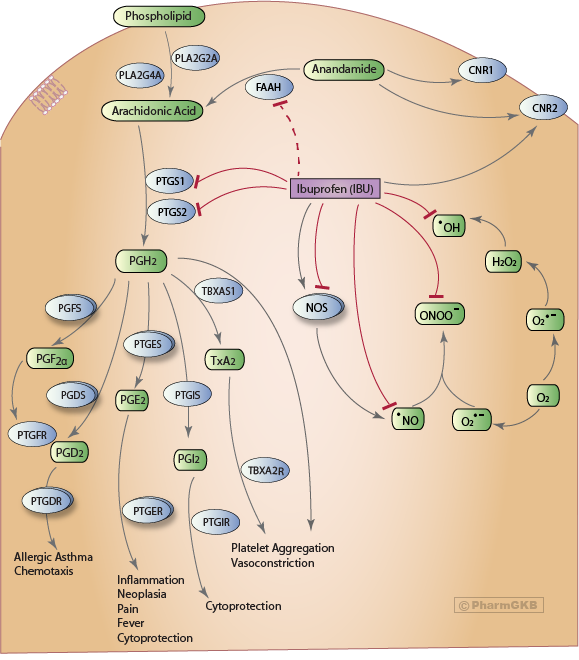
Ibuprofen is a traditional non-steroidal anti-inflammatory drug (NSAID) widely used for its analgesic, anti-inflammatory, and antipyretic properties. The main mechanism of action of ibuprofen is the non-selective, reversible inhibition of the cyclooxygenase enzymes COX-1 and COX-2 (coded for by PTGS1 and PTGS2, respectively). Of the two enantiomers, S-ibuprofen is a more potent inhibitor of COX enzymes than R-ibuprofen, with a stronger inhibitory activity at COX-1 than COX-2 in vitro. COX-1 and COX-2 catalyze the first committed step in the synthesis of prostanoids - prostaglandin (PG) E2, PGD2, PGF2alpha, PGI2 (also known as prostacyclin), and thromboxane (Tx) A2 - from arachidonic acid. Arachidonic acid is released from the cell membrane phospholipids by phospholipase A2, PLA2, encoded by PLA2G4A (cytosolic, calcium-dependent) and PLA2G2A (in platelets and synovial fluid). Arachidonic acid is converted to the unstable intermediate prostaglandin H2 by cytosolic prostaglandin G/H synthases, termed cyclooxygenases, COX, that exist in two forms, COX-1 and COX-2, and are encoded by PTGS1 and PTGS2, respectively. PGH2 is converted by tissue-specific synthases to various prostanoids, i.e. PGE2, PGD2, PGF2alpha, PGI2, and TxA2. These bioactive lipids act through their corresponding receptors to trigger a series of biological effects.
Ibuprofen exerts its anti-inflammatory and analgesic effects through inhibition of both COX isoforms. In addition, ibuprofen scavenges HO . radical, . NO and ONOO - and can potentiate or inhibit nitric oxide formation through its effects on nitric oxide synthase (NOS) isoforms. Ibuprofen may activate anti-nociceptive axis through binding to the cannabinoid receptors and through inhibition of fatty acid amide hydrolase (FAAH) that metabolizes endocannabinoid anandamide.
PGH2, prostaglandin H2; PTGES, prostaglandin E synthase; PGFS, prostaglandin F synthase; TBXAS1, thromboxane A synthase 1; PGDS, prostaglandin D synthase; PTGIS, prostacyclin synthase; PGE2, prostaglandin E2; PGI2, prostacyclin; PGD2, prostaglandin D2; PGF2alpha, prostaglandin F2alpha; TxA2, thromboxane A2; PTGER, prostaglandin E receptors; PTGFR, prostaglandin F receptors; PTGDR, prostaglandin D receptors; PTGIR, prostacyclin receptor; TBXA2R, TxA2 receptor; FAAH, fatty acid amide hydrolase; CNR1 and CNR2, cannabinoid receptors 1 and 2; NOS, nitric oxide synthase; . NO, nitric oxide; O2 -, superoxide anion; ONOO -, peroxynitrite anion; H2O2, hydrogen peroxide.