About this pathway
Antimetabolite drugs were the first widely successful class of drugs developed by rational design for the treatment of cancer [Articles:18860765, 14803432]. They include analogues of purines (thiopurines such as 6-mercaptopurine, 6-thioguanine and azathioprine) pyrimidines (fluoropyrimidines such as 5-fluorouracil, tegafur and capecitabine) and antifolates (methotrexate, pemetrexed and raltitrexed). Although some were designed in the 1950's these drugs are still used today in treatment of leukemia, breast cancer, colorectal cancer and many other cancers [Article:2679902]. Some of these drugs, for example methotrexate and azathioprine, are also used in the management of inflammatory conditions such as rheumatoid arthritis.
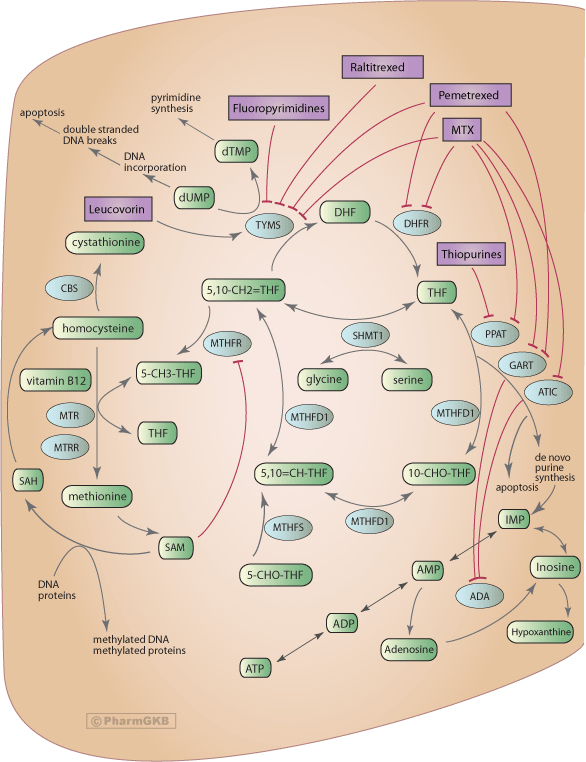
The purpose of this pathway is to show how the pharmacodynamics (PD) for many of the antimetabolite drugs are interconnected. The figure links various antimetabolite drugs and shows how their actions overlap. In order to increase efficacy, antimetabolite drugs are commonly used in combination with other antineoplastic drugs including sometimes other antimetabolites (eg. Methotrexate and 6-mercaptopurine for treatment of ALL) although care much be taken to avoid overlapping side effect profiles [Article:11008002]. Normal intermediates, such as Leucovorin, can also be used to enhance antimetabolite drug action [Article:1911453]. All the antimetabolite drugs depicted here interact in some way with the folate cycle also known as folate-mediated one-carbon metabolism [Articles:16207145, 19952870]. Folate-mediated one-carbon metabolism is essential for synthesis of DNA and activated methyl groups that are required for DNA methylation, regulation of chromatin structure, remethylation of homocysteine as well as methylation of proteins and drugs [Article:19812215]. Disturbance of the folate cycle, whether by inadequate vitamin intake, or variants effecting expression or activity of the genes and products involved, has been associated with a variety of disease conditions including neural tube defects in developing embryos, vascular diseases, cognitive disorders and cancers, reviewed in [Article:11683553]. It is because the folate cycle is so critical for DNA synthesis and cellular functions, that it is a good target for antineoplastic drugs, however it may also be responsible for the drugs adverse effects.
Folate is absorbed from the diet, from green leafy vegetables and as folic acid from supplements or enriched foods. Metabolism of folate to different forms can take place in different cell compartments including the cytoplasm (as shown above), mitochondrion and nucleus (not depicted). Metabolism occurs as part of large multienzyme complexes that perform specific parts of the cycle, reviewed in [Article:19812215].
Pharmacogenomics
There are well known variants for many of the genes involved in the folate pathway including: TYMS:TSER (rs45445694), TYMS:1494del TTAAAG (rs34489327), TYMS:TSER*3G>C (no rs#), DHFR:19bpdel (rs70991108), MTHFR:677C>T (rs1801133), MTHFR:1298A>C (rs1801131), MTR:Asp919Gly (rs1805087), MTRR:66A>G (rs1801394), CBS:844ins68 (no rs#) [Article:19581920].
However, there are currently no guidelines for pharmacogenomic testing involving any of the genes depicted in this pathway (TPMT testing is suggested for thiopurines but this gene is not directly involved in the folate pathway). Several of these variants in the folate pathway are also associated with disease conditions such as neural tube defects and cardiovascular disorder. For more details on these variants and their PGx implications see the VIP and variant annotations and the individual drug pathways:
-
Very Important Pharmacogene Methylenetetrahydrofolate reductase (MTHFR)
-
Very Important Pharmacogene Thymidylate synthase (TYMS)
-
Annotated variants for Dihydrofolate reductase (DHFR)
-
Annotated variants for Methionine synthase (MTR)
-
Annotated variants for Methionine synthase reductase (MTRR)
-
Annotated variants for Methylenetetrahydrofolate dehydrogenase (MTHFD1)
-
Annotated variants for Cystathionine beta synthase (CBS)
-
Fluoropyrimidine Pathway (PD, PK)
-
Methotrexate Pathway
-
Thiopurine Pathway
Reactions & interactions (69)
-
Activation
leucovorin → TYMS
-
Biochemical Reaction
proteins → methylated proteins
-
Biochemical Reaction
5,10-methylenetetrahydrofolate → dihydrofolic acid
-
Biochemical Reaction
adenosine monophosphate → adenosine diphosphate
-
Biochemical Reaction
inosine monophosphate → adenosine monophosphate
-
Biochemical Reaction
deoxyuridine monophosphate → deoxythymidine monophosphate
-
Biochemical Reaction
inosine → hypoxanthine
-
Biochemical Reaction
5,10-methylenetetrahydrofolate → 5,10-methenyltetrahydrofolate
-
Biochemical Reaction
adenosine diphosphate → adenosine triphosphate
-
Biochemical Reaction
adenosine → inosine
-
Biochemical Reaction
tetrahydrofolic acid → 10-formyltetrahydrofolate
-
Biochemical Reaction
5,10-methenyltetrahydrofolate → 10-formyltetrahydrofolate
-
Biochemical Reaction
inosine monophosphate → inosine
-
Biochemical Reaction
5,10-methenyltetrahydrofolate → leucovorin
-
Biochemical Reaction
adenosine monophosphate → adenosine
-
Biochemical Reaction
tetrahydrofolic acid → 5,10-methylenetetrahydrofolate
-
Biochemical Reaction
dihydrofolic acid → tetrahydrofolic acid
-
Biochemical Reaction
5,10-methylenetetrahydrofolate → levomefolic acid
-
Biochemical Reaction
glycine → l-serine
-
Biochemical Reaction
DNA → methylated DNA
-
Biochemical Reaction
dl-homocysteine → cystathionine
-
Biochemical Reaction
methionine → s-adenosylmethionine
-
Biochemical Reaction
s-adenosylhomocysteine → dl-homocysteine
-
Biochemical Reaction
levomefolic acid → tetrahydrofolic acid
-
Biochemical Reaction
dl-homocysteine → methionine
-
Biochemical Reaction
s-adenosylmethionine → s-adenosylhomocysteine
-
Catalysis
methyl transferases → Biochemical Reaction
-
Catalysis
TYMS → Biochemical Reaction
-
Catalysis
TYMS → Biochemical Reaction
-
Catalysis
PPAT → Leads To
-
Catalysis
ATIC → Leads To
-
Catalysis
GART → Leads To
-
Catalysis
MTHFD1 → Biochemical Reaction
-
Catalysis
ADA → Biochemical Reaction
-
Catalysis
MTHFD1 → Biochemical Reaction
-
Catalysis
MTHFD1 → Biochemical Reaction
-
Catalysis
MTHFS → Biochemical Reaction
-
Catalysis
NT5E → Biochemical Reaction
-
Catalysis
SHMT1 → Biochemical Reaction
-
Catalysis
DHFR → Biochemical Reaction
-
Catalysis
MTHFR → Biochemical Reaction
-
Catalysis
SHMT1 → Biochemical Reaction
-
Catalysis
methyl transferases → Biochemical Reaction
-
Catalysis
CBS → Biochemical Reaction
-
Catalysis
cyanocobalamin → Biochemical Reaction
-
Catalysis
MTRR → Biochemical Reaction
-
Catalysis
MTR → Biochemical Reaction
-
Catalysis
MTR → Biochemical Reaction
-
Catalysis
cyanocobalamin → Biochemical Reaction
-
Catalysis
MTRR → Biochemical Reaction
- Showing first 50 of 69 reactions — full data preserved in database.
Edit history (2)
- 2010-03-25 Create
- 2019-06-26 Update Updated gpml to new format.