About this pathway
Metoprolol is a beta-blocker indicated for heart failure and hypertension.
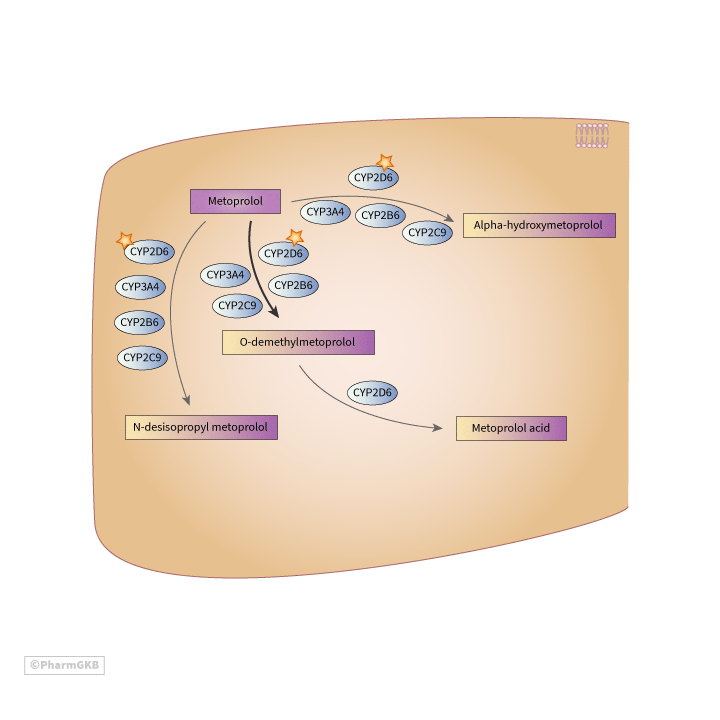
Metoprolol undergoes extensive phase I hepatic metabolism [Article:24648255]. The major route of excretion for metoprolol and its metabolites is through the kidney, with about 5% of the dose excreted in the urine as the parent drug and the rest as metabolites. It is estimated that approximately 100% of the total metoprolol metabolism is mediated through the CYP enzymes, with CYP2D6 the critical pharmacogene although not the exclusive one [Article:30087611][Article:16192109]. Metoprolol is metabolized 3 main routes: o-demethylation (approximately 65%), alpha-hydroxylation (10%) and n-dealkylation (10%)[Article:2222517][Article:30087611]. Inhibition with quinidine, a specific inhibitor of CYP2D6, showed that there was still a residual amount of flux of 4% for a-hydroxylation, 8% for N-dealkylation, and 19% for O-demethylation of metoprolol [Article:30087611].
The major metabolic pathway for metoprolol is O-demethylation [Article:30087611][Article:25291152][Article:2222517]. This metabolite is transient in nature and undergoes subsequent rapid oxidation to metoprolol acid, an inactive carboxylic acid metabolite and the main metabolite found in urine of man [Article:25291152]. This route is stereoselective for the R-metoprolol enantiomer [Article:2222517]. The main enzyme responsible for this step is CYP2D6, however experiments in human liver microsomes using specific inhibitors demonstrated that CYP3A4, CYP2B6 and CYP2C9 contribute in a minor way to all three routes of metabolism [Article:30087611]
Alpha-hydroxylation results in the active metabolite alpha-hydroxymetoprolol which exhibits an in vitro potency approximately one tenth of metoprolol [Article:25291152][Article:30087611]. This pathway is stereoselective for the S-metoprolol enantiomer [Article:25291152].
The third route is N-dealkylation to form n-desisopropyl metoprolol [Article:30087611].
Reactions & interactions (17)
-
Biochemical Reaction
metoprolol → N-desisopropyl metoprolol
-
Biochemical Reaction
metoprolol → alpha-hydroxymetoprolol
-
Biochemical Reaction
metoprolol → o-demethylmetoprolol
-
Biochemical Reaction
o-demethylmetoprolol → metoprolol acid
-
Catalysis
CYP2B6 → Biochemical Reaction
-
Catalysis
CYP2C9 → Biochemical Reaction
-
Catalysis
CYP3A4 → Biochemical Reaction
-
Catalysis
CYP2D6 → Biochemical Reaction
-
Catalysis
CYP2C9 → Biochemical Reaction
-
Catalysis
CYP2B6 → Biochemical Reaction
-
Catalysis
CYP3A4 → Biochemical Reaction
-
Catalysis
CYP2D6 → Biochemical Reaction
-
Catalysis
CYP3A4 → Biochemical Reaction
-
Catalysis
CYP2B6 → Biochemical Reaction
-
Catalysis
CYP2C9 → Biochemical Reaction
-
Catalysis
CYP2D6 → Biochemical Reaction
-
Catalysis
CYP2D6 → Biochemical Reaction
Edit history (1)
- 2018-06-07 Create