About this pathway
Background
Carvedilol is beta-blocking drug approved for use in heart failure, left ventricular dysfunction after myocardial infarction and hypertension (label). racemic mixture consisting of the R-enantiomer, which mediates alpha1 adrenergic receptor blockade only (coded for by ADR1A1, ADR1B1, ADR1D1), and the S-enantiomer which is a non-subtype selective blocker of alpha1 and beta1 (ADRB1) and beta2 (ADRB2) receptors [Article:26537419]. Carvedilol is a highly lipophilic drug which is rapidly absorbed from the GI tract [Article:30086658]. It undergoes stereoselective first-pass metabolism with a preference for R-carvedilol [Article:26537419]. Both enantiomers are hepatically metabolized with <1% of the dose excreted in the urine as the parent drug [Article:7914479]. The main pathways of carvedilol metabolism include oxidation (ring & side chain), demethylation and glucuronidation and there are several key pharmacogenes involved [Article:9280405][Article:26537419][Article:30086658][Article:1823868].
Metabolism
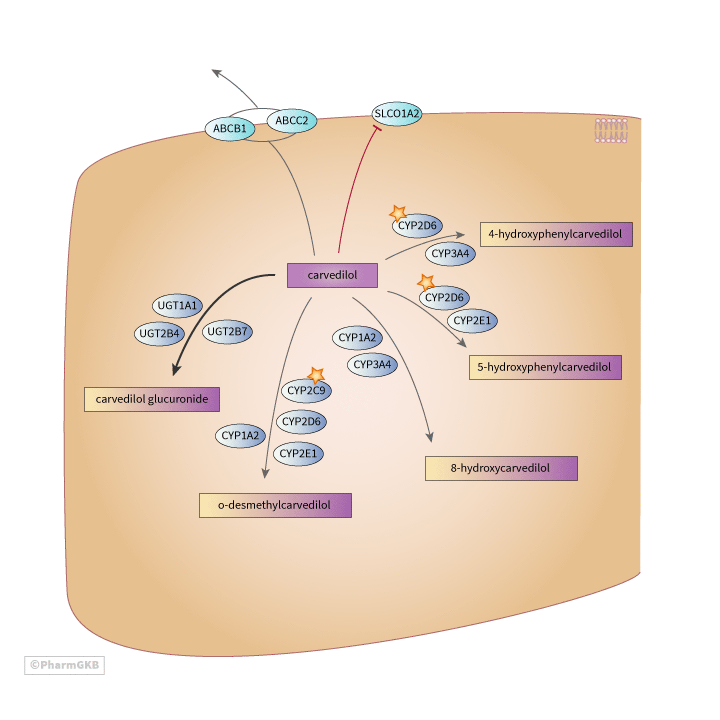
In vitro experiments with human liver microsomes, inhibitors of cytochrome P450 enzymes (CYPs), and recombinant CYP proteins showed that R-carvedilol was primarily metabolized by CYP2D6 (40%) with contributions from CYP3A4 (30%), CYP1A2 (20%) and CYP2C9 whereas S-carvedilol was mostly metabolized by CYP1A2 (60%) with 20% CYP2D6 and 15% CYP3A4 [Article:27836712].
Aromatic ring oxidation of carvedilol creates two hydroxylated active metabolites namely 4-hydroxycarvedilol and 5-hydroxycarvedilol primarily by CYP2D6 [Article:26537419][Article:9280405]. Side-chain oxidation leads to two hydroxylated inactive metabolites namely 1 and 8-hydroxycarvedilol with CYP1A2 the main catalyst [Article:27836712][Article:9280405].
Demethylation of carvedilol results in an active metabolite O-desmethylcarvedilol catalyzed by primarily by CYP2C9, although it only has minor beta-blocking action and no activity with the alpha1 adrenergic receptors [Article:1823868]. Despite the predominate role of CYP2C9, O-desmethylcarvedilol plasma concentrations are detectable in CYP2C9 poor metabolizer individuals who lack any CYP2C9 activity, which suggest that other cytochrome P450 enzymes can be involved in the O-desmethylcarvedilol production. In-vitro experiments implicate the partial involvement of CYP2D6, CYP1A2, and CYP2E1 in the formation of O-desmethylcarvedilol in human liver microsomes [Article:9280405].
In phase II metabolism carvedilol and phase I metabolites are inactivated by glucuronidation in the liver. In humans UGT1A1, UGT2B4 and UGT2B7 are responsible for glucuronidation of the parent drug [Article:14744946][Article:22814440]; those involved in metabolite conjugation are not yet characterized and not depicted in the figure. In vitro glucuronidation of the racemic carvedilol in human liver microsomes shows stereoselective preference for S-carvedilol at all concentrations [Article:22814440]. Whereas in intestinal microsomes, S-carvedilol is preferred at low concentrations but R-carvedilol at high concentrations [Article:22814440].
Transport
Carvedilol and its hydroxylated metabolites are substrates for ABCB1 (also called Pgp or MDR1) and ABCC2 (MRP2) [Article:15001973]. in healthy volunteers, increased expression of intestinal ABCB1 and ABCC2, by treatment with rifampin, was associated with decreased plasma carvedilol [Article:15001973]. Expression of ABCB1 and ABCC2 was not influenced by the pharmacogenomics variants tested but the sample size was very small (n=12) and may have more relevance in patients receiving other drugs that are substrates of these transporters [Article:15001973]. While carvedilol is not a substrate of SLCO1A2 (OATP1A2) it can inhibit uptake of rosuvastatin in vitro so there is a potential for drug-drug interactions [Article:25563901].
Reactions & interactions (22)
-
Biochemical Reaction
carvedilol → 4'-hydroxyphenyl carvedilol
-
Biochemical Reaction
carvedilol → 5'-hydroxyphenyl carvedilol
-
Biochemical Reaction
carvedilol → o-desmethyl carvedilol
-
Biochemical Reaction
carvedilol → carvedilol glucuronide
-
Biochemical Reaction
carvedilol → 8-hydroxycarvedilol
-
Catalysis
ABCB1 → Transport
-
Catalysis
ABCC2 → Transport
-
Catalysis
CYP2D6 → Biochemical Reaction
-
Catalysis
CYP3A4 → Biochemical Reaction
-
Catalysis
CYP2D6 → Biochemical Reaction
-
Catalysis
CYP2E1 → Biochemical Reaction
-
Catalysis
CYP1A2 → Biochemical Reaction
-
Catalysis
CYP2D6 → Biochemical Reaction
-
Catalysis
CYP2E1 → Biochemical Reaction
-
Catalysis
CYP2C9 → Biochemical Reaction
-
Catalysis
UGT2B7 → Biochemical Reaction
-
Catalysis
UGT2B4 → Biochemical Reaction
-
Catalysis
UGT1A1 → Biochemical Reaction
-
Catalysis
CYP3A4 → Biochemical Reaction
-
Catalysis
CYP1A2 → Biochemical Reaction
-
Inhibition
carvedilol → SLCO1A2
-
Transport
carvedilol → carvedilol
Edit history (3)
- 2018-06-06 Create
- 2020-04-23 Update Corrected typo
- 2024-01-18 Correction The arrow depicting transport via ABCB1 and ABCC2 was corrected to show drug efflux not influx. The underlying gpml was directionally correct and no changes were made to the gpml.