About this pathway
Fluoropyrimidines are antimetabolite drugs widely used in the treatment of cancer including colorectal and breast cancer and cancers of the aerodigestive tract. The response to the fluoropyrimidine 5-fluorouracil (5-FU) as a first line monotherapy is low (10-15% for advanced colorectal cancer), so it is often given as part of a regimen with other cytotoxic drugs such as oxaliplatin (known as FOLFOX) and irinotecan (FOLFIRI). This increases drug efficacy with response rates in the range of 40-50% for advanced colorectal cancer. As a consequence of these common co-treatments the study of in vivo pharmacogenomic effects of 5FU can be complicated. Candidate genes for fluoropyrimidines have also been found by expression studies, treating cells in vitro to identify markers of drug resistance and sensitivity, although most of these have yet to be validated in patient studies [Articles:16510598, 19219653, 19339911, 15548681, 16709241, 19302291].
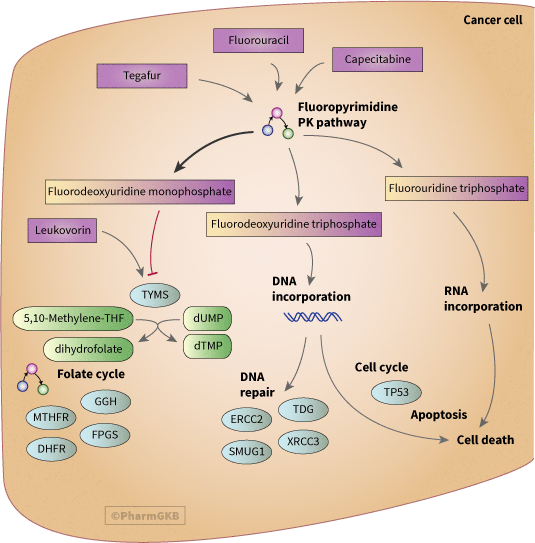
The principal mechanism of action of fluoropyrimidines has been considered to be the inhibition of thymidylate synthase (TYMS), but recent evidence has also shown alternative pharmacodynamic pathways acting through incorporation of drug metabolites into DNA and RNA. The fluoropyrimidines are broken down into three metabolites that have pharmacodynamic effects, fluorodeoxyuridine monophosphate (FdUMP), fluoro-deoxyuridine triphosphate (FdUTP) and fluorouridine triphosphate (FUTP) (see PK pathway for more details) that act through these different mechanisms. In the clinic, 5FU is commonly given either as bolus injection with leucovorin (LV; 5-formyl tetrahydrofolate) or a continuous infusion. The mechanism of action of 5FU may differ with different modes of administration, with bolus treatment favoring RNA damage and continuous treatment favoring DNA damage [Articles:19383847, 8996164].
FdUMP forms a covalent complex with TYMS [Article:15638735] and prevents the binding and conversion of dUMP to dTMP, necessary for pyrimidine and DNA synthesis, and blocks the simultaneous conversion of 5, 10-methylene tetrahydrofolate to dihydrofolate, a key component of the folate pathway that recycles methyl groups and synthesizes methionine. The inhibition of TYMS leads to an imbalance of dUTP and dTTP and a rise in misincorporation of dUTP into DNA [Article:19402749]. The complex of FdUMP and TYMS is stabilized by coadministration of folate analogues that can bind in place of 5,10-methylene THF, such as LV (5-formyl tetrahydrofolate) [Article:15638735]. The protein functions as a dimer with both subunits binding both nucleotide and folate. Several structures of TYMS have been generated although many are of non-human proteins and no structure was available showing the human TYMS crystallized with FdUMP (PDB:1TSN shows FdUMP with E.coli TYMS).
Due to its involvement in the metabolism of endogenous folates, administration of LV, folates and the activity of other folate cycle enzymes can impact the activity of TYMS. GGH and FPGS expression affect the levels of reduced folate in human colon cancer cells in vitro and thus determine LV enhancement of 5FU cytotoxicity [Article:18035049]. DHFR expression has been shown to be altered in tumor cells compared to normal cells [Article:15814641] and although not a direct target for fluoropyrimidines as it is for methotrexate, it may affect fluoropyrimidine PD via changes in folate availability. The phenotype of the tumor may also be important with respect to the folate and methylation side of this pathway. For example, the CpG island methylator phenotype (CIMP+) of colorectal cancer, in which gene promoters are hypermethylated, has been associated with positive outcomes to 5FU-based treatments [Article:19093176].
There is some debate as to whether DNA damage caused by incorporation of dUTP or FdUTP into DNA is the cause of cytotoxicity of fluoropyrimidines [Article:19402749]. Whether it is uracil or 5FU incorporation into DNA, the resultant damage occurs due to increased base excision repair causing DNA fragmentation and ultimately cell death. SMUG1, a uracil-DNA glycosylase excises 5FU from DNA and protects against cell death in vitro [Article:17283124]. A recent paper gives in vitro evidence that thymidine DNA glycosylase, TDG is the main base excision enzyme responsible for 5FU excision related DNA strand breaks [Article:19402749].
TYMS variants have been associated with TYMS expression and response to fluorouracil chemotherapy, reviewed in [Articles:16267625, 17716232] (see TYMS VIP annotation for further details). Despite many studies examining the effects of these variants, contradictory findings from heterogeneous studies have meant that a clear predictive strategy has not been developed for clinical use. A recent study of copy number variation in TYMS in colorectal tumor samples showed high copy numbers were associated with disease relapse and death [Article:18607850] indicating that simple genotyping may not provide the whole picture. There is conflicting data on the impact of MTHFR variants on fluoropyrimidine PD (for more details on these variants see the MTHFR VIP annotation). A recent review [Article:19144510] discusses the impact of MTHFR variants on tumor response, disease progression, survival and toxicity, noting that many of the studies that showed no impact of these variants involved co-treatment with additional antineoplastic drugs whereas those that showed correlations involved treatment with fluoropyrimidines alone or with LV. They, and others, suggest a pathway-based multi-variant approach may prove the most effective for predicting fluoropyrimidine drug response [Articles:19144510, 16785472, 15814641]. There have been some additional publications implicating variants in DNA repair enzymes and cell cycle pathways in the pharmacogenomics of fluoropyrimidines in vivo [Articles:17549067, 18267032, 18357466]. Although pictured in the graphic with the cell cycle and apoptosis part of the pathway, this TP53 variant may exert effects via regulation of MTHFR and DHFR as shown in a study of breast cancer patients treated with 5FU and mitomycin [Article:18498133].
In summary, while fluoropyrimidines have been used in the clinic for over 50 years, and several of the candidate genes in the PD pathway have been shown to influence clinical outcomes, much of the data is contradictory and complicated by combination treatment regimens. Consequently, a definitive prognostic or predictive testing strategy has not yet been proven.
Reactions & interactions (29)
-
Activation
FPGS → Antimetabolite Pathway - Folate Cycle, Pharmacodynamics
-
Activation
MTHFR → Antimetabolite Pathway - Folate Cycle, Pharmacodynamics
-
Activation
DHFR → Antimetabolite Pathway - Folate Cycle, Pharmacodynamics
-
Activation
GGH → Antimetabolite Pathway - Folate Cycle, Pharmacodynamics
-
Activation
leucovorin → TYMS
-
Biochemical Reaction
5,10-methenyltetrahydrofolate → dihydrofolic acid
-
Biochemical Reaction
deoxyuridine monophosphate → deoxythymidine monophosphate
-
Biochemical Reaction
tegafur → fluorouracil
-
Biochemical Reaction
fluorouracil → fluorodeoxyuridine triphosphate
-
Biochemical Reaction
fluorouracil → fluorodeoxyuridine monophosphate
-
Biochemical Reaction
capecitabine → fluorouracil
-
Biochemical Reaction
fluorouracil → fluorouridine triphosphate
-
Catalysis
TYMS → Biochemical Reaction
-
Catalysis
XRCC3 → Leads To
-
Catalysis
SMUG1 → Leads To
-
Catalysis
TDG → Leads To
-
Catalysis
ERCC2 → Leads To
-
Catalysis
TYMS → Biochemical Reaction
-
Catalysis
Fluoropyrimidine Pathway, Pharmacokinetics → Biochemical Reaction
-
Catalysis
Fluoropyrimidine Pathway, Pharmacokinetics → Biochemical Reaction
-
Catalysis
Fluoropyrimidine Pathway, Pharmacokinetics → Biochemical Reaction
-
Inhibition
fluorodeoxyuridine monophosphate → TYMS
-
Leads To
fluorouridine triphosphate → damage
-
Leads To
dihydrofolic acid → Antimetabolite Pathway - Folate Cycle, Pharmacodynamics
-
Leads To
DNA damage [MESH:D004249] → apoptosis
-
Leads To
fluorodeoxyuridine triphosphate → DNA damage [MESH:D004249]
-
Leads To
damage → apoptosis
-
Leads To
TP53 → apoptosis
-
Leads To
DNA damage [MESH:D004249] → DNA repair [MESH:D004260]
Edit history (4)
- 2010-05-02 Create
- 2019-02-22 Update Updated to new illustrator formatting.
- 2019-06-24 Update Updated to new gpml format.
- 2022-09-29 Update fixed typo