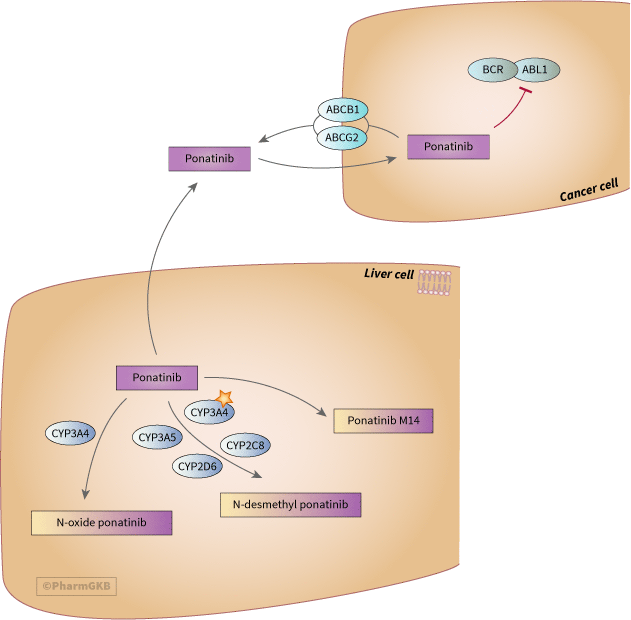
About this pathway
Ponatinib is a small molecule, orally active drug approved by US-FDA for treatment of chronic myeloid leukemia (CML) and Philadelphia chromosome-positive acute lymphoblastic leukemia (Ph+ ALL) [Article:25764322]. It is a tyrosine kinase inhibitor (TKI) directed against the ABL1 kinase of BCR-ABL. The drug was briefly suspended due to a high rate of cardiovascular adverse events. It was later re-introduced to the market by US-FDA with its indication restricted to those with gatekeeper BCR-ABL mutation or who have failed all other TKIs. [Article:24449310]. Common adverse events associated with ponatinib therapy are dry skin, rash, abdominal pain, thrombocytopenia, neutropenia and anemia [Article:24180494].
The gatekeeper T315I mutation of ABL1 affects approximately 15% of patients with chronic CML resistant to TKI therapy. This mutation alters the ATP-binding pocket of BCR-ABL protein, filling the pocket with bulkier Ile group that interferes with the binding of all approved first and second generation TKIs [Article:17785585]. Unlike other TKIs, Ponatinib competes with ATP to bind to the ‘DFG out’ conformation of BCR-ABL tyrosine kinase, overcoming resistance to T315I mutation [Articles:24265264, 19878872].
Ponatinib undergoes both phase 1 and 2 hepatic metabolism to a N-desmethyl metabolite, which is four-fold less active than ponatinib. It is mainly metabolized by CYP3A4 and to a lesser extent CYP2C8, CYP2D6 and CYP3A5 [Articles:24807266, 24265264]. Concurrent therapy with CYP3A4 inhibitors like ketoconazole resulted in higher ponatinib AUC and Cmax in healthy volunteers. Thus, co-administration with strong CYP3A4 inhibitors and inducers should be carefully considered in patients undergoing ponatinib treatment.
Reactions & interactions (14)
-
Biochemical Reaction
ponatinib → n-oxide ponatinib
-
Biochemical Reaction
ponatinib → n-desmethyl ponatinib
-
Biochemical Reaction
ponatinib → ponatinib M14
-
Catalysis
CYP3A4 → Biochemical Reaction
-
Catalysis
CYP3A4 → Biochemical Reaction
-
Catalysis
CYP2C8 → Biochemical Reaction
-
Catalysis
CYP3A5 → Biochemical Reaction
-
Catalysis
CYP2D6 → Biochemical Reaction
-
Catalysis
ABCG2 → Transport
-
Catalysis
ABCB1 → Transport
-
Inhibition
ponatinib → BCR-ABL
-
Transport
ponatinib → ponatinib
-
Transport
ponatinib → ponatinib
-
Transport
ponatinib → ponatinib
Edit history (2)
- 2018-03-27 Create
- 2019-02-20 Update Updated to new illustrator formatting.