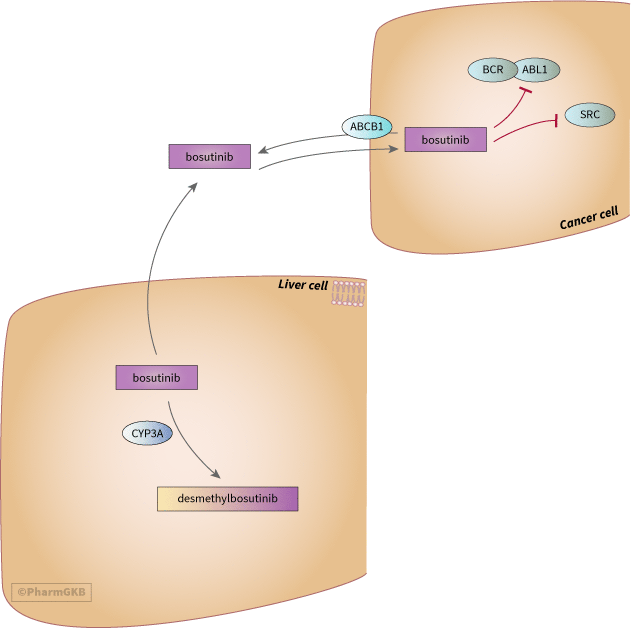
About this pathway
Background
Bosutinib (SKI-606) is a small molecule, orally active drug approved by US-FDA for treatment of chronic, accelerated and blast-phase chronic myeloid leukemia (CML) [Article:25736937]. It is a second-generation dual ABL/SRC tyrosine kinase inhibitor effective against most imatinib-resistant myeloid tumors, except T315I and V299L mutations [Articles:25736937, 17114238, 19039322].
Pharmacokinetics
Absorption of bosutinib is aided by administering with food, with an increase of exposure approximately twofold greater than taken under fasting conditions [Article:21691746]. This is likely due to increased solubility under acid conditions. Long-lasting acid reducing medications such as proton pump inhibitors PPIs, such as lansoprazole, can therefore interfere with bosutinib reducing plasma drug levels by almost 50% in healthy volunteers [Article:23839484].
Bosutinib is mainly metabolized in the liver by CYP3A4 and its metabolites are generally considered inactive [Articles:21148045, 27182477]. The major metabolite is desmethylbosutinib (M5, Pubchem CID 5328944) and represents around 25% of parent drug. Other metabolites not depicted in Figure 1 are oxydechlorinated (M2) bosutinib (19%) and n-oxide bosutinib (M6) (trace amounts) [Article:27182477]. Pubchem records suggest that M5/CID 5328944 has some activity against SRC [Article:11689083].
Common adverse events associated with bosutinib treatment are diarrhea, nausea and vomiting [Article:25736937]. In patients with varying degrees of hepatic impairment, significant increase in bosutinib exposure and T1/2 and decrease in oral clearance was observed (described without references in the drug label)[Article:25736937]. This may be due to decreased CYP3A4, since CYP3A4 concentrations are reduced by 75% in patients with chronic liver disease [Article:7806144]. In addition, increase in bosutinib exposure was observed upon concomitant administration of CYP3A4 inhibitor ketoconazole [Article:21148045]. Thus, bosutinib dose adjustments may be warranted when administered in conjunction with CYP3A4 inhibitors or to patients with hepatic impairment.
Clinical pharmacogenomic studies associated with bosutinib treatment have not been reported. However, in vitro studies in myeloid tumor cell lines demonstrated that bosutinib is a weak affinity substrate for ABCB1 and that variants rs9282564, rs2229109, rs1128503, rs2235036, rs2032582 and rs1045642 did not influence bosutinib toxicity [Article:24019750]. Another in vitro study concluded that ABCB1 and ABCG2 overexpression did not protect cells against bosutinib toxicity [Article:19785662].
Pharmacodynamics
While the main target for bosutinib is ABL1 of the BCR-ABL fusion, characteristic of CML, activity with other kinases is also important for additional effects both beneficial and side effects. In vitro studies of CML patient cells, cell lines and expressed proteins suggest 45 other proteins as possible additional targets of bosutinib [Article:19039322]. Of note were CAMK2G, which has been associated with increased proliferation of leukemia cells [Article:18483256], TNK2 which is associated with poor prognosis in a variety of cancers [Article:25347744] and STE20 kinase MST4, MST1 and MST3 which are involved in apoptosis [Article:19039322].
Reactions & interactions (9)
-
Biochemical Reaction
bosutinib → desmethylbosutinib
-
Catalysis
ABCB1 → Transport
-
Catalysis
CYP3A4 → Biochemical Reaction
-
Inhibition
bosutinib → SRC
-
Inhibition
bosutinib → BCR-ABL
-
Inhibition
ketoconazole → CYP3A4
-
Transport
bosutinib → bosutinib
-
Transport
bosutinib → bosutinib
-
Transport
bosutinib → bosutinib
Edit history (2)
- 2018-03-22 Create
- 2018-09-20 Update Update of image files for formatting.