About this pathway
Background
Second generation, atypical, antipsychotics such as clozapine, olanzapine, and risperidone, are first line treatment for schizophrenia [Articles:20238348, 19909227]. These antipsychotics are associated with a high likelihood of weight gain [Articles:17291373, 23810019]. Also elevated is risk for metabolic syndrome: a combination of high waist to hip ratio, elevated triglycerides, low HDL, hypertension and insulin resistance [Articles:27441116, 26107755]. Another metabolic side effect for this drug class is elevated prolactin, hyperprolactinemia, which can result in amenorrhea and infertility in women or testosterone deficiency and breast enlargement in men [Article:26872113].
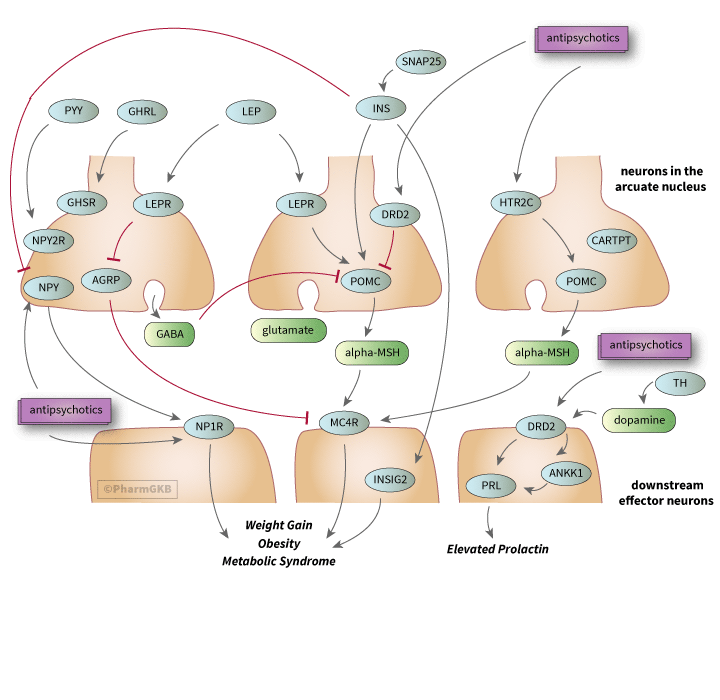
This pathway shows candidate genes involved in the pharmacodynamics of antipsychotics focusing on the metabolic side effects. The relationships depicted show possible connections that are implicated in the process rather than direct interactions.
Neurons of the Arcuate Nucleus
Signals from around the body that regulate food intake and energy metabolism and expenditure include insulin (released from the pancreas), leptin (adipose), ghrelin (stomach) and PYY (distal GI tract) that act on neurons in the arcuate nucleus of the hypothalamus. Depicted are neurons that release the orexigenic Agouti-related peptide (AGRP) and neuropeptide Y (NPY) which stimulate appetite and eating behaviour, and neurons that release anorexigenic peptides proopiomelanocortin (POMC) and cocaine and amphetamine regulated transcript (CARTPT) [Article:15703762]. In the arcuate nucleus of the hypothalamus POMC is cleaved to produce alpha-MSH, in other cell types products include adrenocorticotropin and beta-endorphin and met-enkephalin.
HTR2C and leptin receptors are expressed by distinct subpopulations of arcuate nucleus POMC neurons [Article:21835345]. Both 5-HT and leptin exert their actions in POMC secreting neurons via transient receptor potential C (TRPC) channels that include phospholipase C although the genes that code for these proteins are not established [Article:21835345].
Reactions & interactions (31)
-
Activation
INS → CARTPT
-
Activation
<i>antipsychotics</i> → HTR2C
-
Activation
NPY → NPY1R
-
Activation
<i>antipsychotics</i> → DRD2
-
Activation
LEPR → POMC
-
Activation
LEP → LEPR
-
Activation
SNAP25 → INS
-
Activation
HTR2C → POMC
-
Activation
<i>antipsychotics</i> → NPY1R
-
Activation
<i>antipsychotics</i> → NPY
-
Activation
GHRL → GHSR
-
Activation
INS → POMC
-
Activation
INS → INSIG2
-
Activation
ANKK1 → PRL
-
Activation
DRD2 → ANKK1
-
Activation
dopamine → DRD2
-
Activation
DRD2 → PRL
-
Inhibition
INS → NPY
-
Inhibition
LEP → AGRP
-
Inhibition
DRD2 → POMC
-
Inhibition
INS → AGRP
-
Inhibition
<i>antipsychotics</i> → TH
-
Inhibition
AGRP → MC4R
-
Inhibition
PYY → NPY2R
-
Leads To
HTR2C → Weight gain
-
Leads To
MC4R → Weight gain
-
Leads To
HTR2C → Metabolic Syndrome
-
Leads To
TH → dopamine
-
Leads To
INSIG2 → Weight gain
-
Leads To
INSIG2 → Metabolic Syndrome
-
Leads To
PRL → Hyperprolactinemia
Edit history (2)
- 2017-10-31 Create
- 2019-02-20 Update Updated to new illustrator formatting.