About this pathway
Background
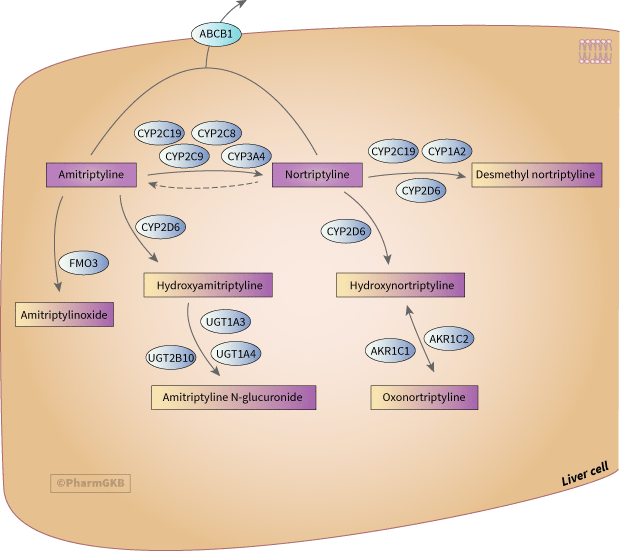
Amitriptyline and nortriptyline are tricyclic antidepressants originally designed for use in the treatment of depression. Amitriptyline is also used to treat various types of pain such as fibromyalgia and neuropathic pain [Article:15554244]. Nortriptyline is a metabolite of amitriptyline as well as a drug in its own right [Articles:15554244, 18359012]. Both drugs are non-selective monoamine reuptake inhibitors, preventing the re-uptake of norepinephrine and serotonin at nerve terminals via interaction with their respective transporters, SLC6A2 and SLC6A4, and potentiating the action of these neurotransmitters. Additional effects and side effects occur due to cross-reactivity with opioid, cholinergic and adrenergic receptors [Articles:8736630, 10319193].
Metabolism
Amitriptyline and nortriptyline are readily absorbed in the GI tract and subject to extensive hepatic metabolism with less than 5% of drug eliminated unchanged (reviewed in [Article:10319193]). The main metabolizing enzymes with clinical significance for amitriptyline are CYP2C19 and CYP2D6 [Articles:23486447, 27997040]. CYP2C19 is the major enzyme responsible for demethylation at physiological concentrations, while CYP2D6 carries out hydroxylation to less active metabolites [Articles:15554244, 18359012]. Hydroxynortriptyline is the most abundant metabolite of both amitriptyline and nortriptyline in humans [Article:10319193]. There are two enantiomers of hydroxynortriptyline and the E enantiomer is produced at a rate of around 5 times that of the Z enantiomer [Article:10319193]. Methylation of nortriptyline to amitriptyline has been reported in vivo in some case studies. A study that examined metabolite and prescription data from a large network of medical centers for whom amitriptyline measurements were available found that approximately 15% of patients receiving nortriptyline had significant levels of amitriptyline (above 28ng/ml) despite not having received the parent drug [Article:16553509]. The mechanism for methylation was not elucidated.
Pharmacogenomics
Many studies have examined variation in drug metabolizing enzymes for their impact on amitriptyline and nortriptyline pharmacokinetics with most focusing on CYP2D6 and CYP2C19. CPIC guidelines are available for both CYP2D6 and CYP2C19 and amitriptyline [Article:23486447]. Links to individual papers can be found under the PGx Research tab for amitriptyline and nortriptyline and clinical annotation summaries by haplotype under the Clinical PGx tab.
Reactions & interactions (27)
-
Biochemical Reaction
nortriptyline → amitriptyline
-
Biochemical Reaction
nortriptyline → desmethylnortriptyline
-
Biochemical Reaction
nortriptyline → hydroxynortriptyline
-
Biochemical Reaction
amitriptyline → nortriptyline
-
Biochemical Reaction
hydroxyamitriptyline → amitriptyline n-glucuronide
-
Biochemical Reaction
amitriptyline → hydroxyamitriptyline
-
Biochemical Reaction
amitriptyline → amitriptylinoxide
-
Biochemical Reaction
hydroxynortriptyline → oxonortriptyline
-
Catalysis
CYP1A2 → Biochemical Reaction
-
Catalysis
CYP2D6 → Biochemical Reaction
-
Catalysis
CYP2C19 → Biochemical Reaction
-
Catalysis
ABCB1 → Transport
-
Catalysis
CYP2D6 → Biochemical Reaction
-
Catalysis
CYP2C8 → Biochemical Reaction
-
Catalysis
CYP2C9 → Biochemical Reaction
-
Catalysis
CYP3A4 → Biochemical Reaction
-
Catalysis
CYP2C19 → Biochemical Reaction
-
Catalysis
ABCB1 → Transport
-
Catalysis
UGT1A3 → Biochemical Reaction
-
Catalysis
UGT1A4 → Biochemical Reaction
-
Catalysis
UGT2B10 → Biochemical Reaction
-
Catalysis
CYP2D6 → Biochemical Reaction
-
Catalysis
FMO3 → Biochemical Reaction
-
Catalysis
AKR1C2 → Biochemical Reaction
-
Catalysis
AKR1C1 → Biochemical Reaction
-
Transport
nortriptyline → nortriptyline
-
Transport
amitriptyline → amitriptyline
Edit history (2)
- 2017-04-21 Create
- 2019-02-19 Update Updated to new illustrator formatting.