About this pathway
Background
Pravastatin is an HMG-CoA reductase inhibitor or statin used for the prevention of cardiovascular disease in hypercholesterolemia patients. Similar to other statins, pravastatin inhibits endogenous cholesterol production by competitive inhibition of 3-hydroxy-3-methylglutaryl coenzyme A reductase (HMGCR), the enzyme that catalyzes conversion of HMG-CoA to mevalonate depicted in the Statin Pathway, Pharmacodynamics.
Guidelines regarding the use of pharmacogenomic information in dosing for pravastatin were published by the Clinical Pharmacogenetic Implementation Consortium (CPIC). CPIC recommends reduced pitavastatin starting dose for patients with SLCO1B1 poor or decreased function phenotype.
Metabolism
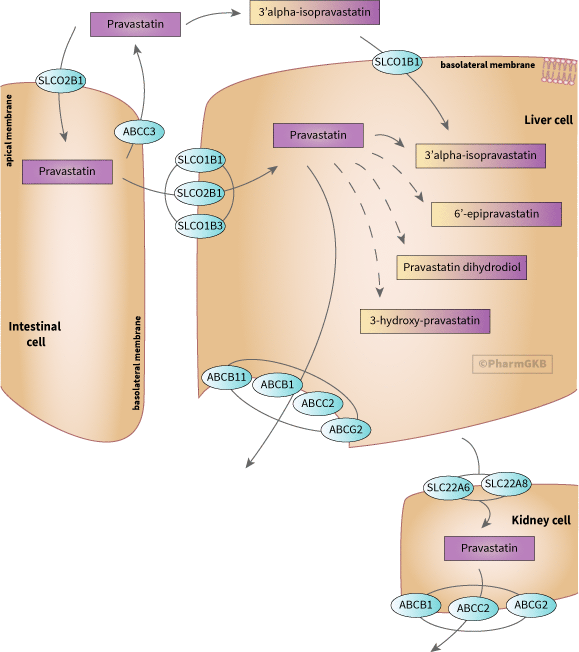
Pravastatin is administered in the active form and can be extensively metabolized to active and inactive metabolites in the liver [Article:10490896]. However, pravastatin is one of the hydrophilic statins along with rosuvastatin and pitavastatin that are mostly eliminated unchanged [Article:17178259].
Transport
Pravastatin is a substrate of organic anion transporters SLCO1B1, SLCO1B3 and SLCO2B1 [Articles:16198652, 15970799, 15864131, 16103896, 15564882, 15226675], as well as SLC22A6 and SLC22A8 [Article:12811365]. It is also a substrate of the efflux transporters such as ABCB1, ABCB11, ABCC2, ABCC3 and ABCG2 [Articles:34162690, 16107564, 15901800, 15901796, 15616150, 15226675, 11902809].
Genetic variations in the SLCO1B1 gene have been linked to increased exposure and decreased clearance of pravastatin. Carriers of the rs4149056 (521T>C) C allele had increased AUC of pravastatin [Articles:12811365, 15116054, 15226675, 16678544, 17047488, 17622941, 18408565, 19776292, 30549267, 26744986, 17622941], which may also lead to increased risk of statin-related muscle symptoms. However, in the STRENGTH (Statin Response Examined by Genetic Haplotype Markers) study, rs4149056 is not significantly associated with adverse events in individuals that received pravastatin [Article:19833260]. The effect of rs4149056 on efficacy is also minimal for pravastatin [Articles:22189199, 16678544, 17439540, 25379722].
Reactions & interactions (28)
-
Biochemical Reaction
pravastatin → 3'alpha-isopravastatin
-
Biochemical Reaction
pravastatin → 3-hydroxy-pravastatin
-
Biochemical Reaction
pravastatin → pravastatin dihydrodiol
-
Biochemical Reaction
pravastatin → 3'alpha-isopravastatin
-
Biochemical Reaction
pravastatin → 6'-epipravastatin
-
Catalysis
ABCC3 → Transport
-
Catalysis
SLCO1B1 → Transport
-
Catalysis
SLC22A6 → Transport
-
Catalysis
SLC22A8 → Transport
-
Catalysis
SLCO2B1 → Transport
-
Catalysis
ABCC3 → Transport
-
Catalysis
ABCC2 → Transport
-
Catalysis
ABCB1 → Transport
-
Catalysis
ABCB11 → Transport
-
Catalysis
ABCG2 → Transport
-
Catalysis
SLCO1B1 → Transport
-
Catalysis
SLCO2B1 → Transport
-
Catalysis
SLCO1B3 → Transport
-
Catalysis
ABCC2 → Transport
-
Catalysis
ABCB1 → Transport
-
Catalysis
ABCG2 → Transport
-
Transport
pravastatin → pravastatin
-
Transport
3'alpha-isopravastatin → 3'alpha-isopravastatin
-
Transport
pravastatin → pravastatin
-
Transport
pravastatin → pravastatin
-
Transport
pravastatin → pravastatin
-
Transport
pravastatin → pravastatin
-
Transport
pravastatin → pravastatin
Edit history (5)
- 2006-03-08 Create
- 2011-03-31 Update
- 2022-02-20 Update Pathway updated to include specific metabolites, new gpml, new figure and text.
- 2022-02-20 Update Linked related statin pathways.
- 2024-09-05 Update fixed typo