About this pathway
Background
Rosuvastatin is a lipid lowering drug belong to the class of the 3-hydroxy-3-methylglutaryl coenzyme A (HMG-CoA) reductase inhibitors (statins). Rosuvastatin inhibits endogenous cholesterol production by competitive inhibition of 3-hydroxy-3-methylglutaryl coenzyme A reductase (HMGCR), the enzyme that catalyzes conversion of HMG-CoA to mevalonate [Article:18363544] depicted in the Statin Pathway, Pharmacodynamics. Rosuvastatin dose dependently reduces elevated LDL-cholesterol and reduces total cholesterol and triglycerides and increases HDL-cholesterol. It is also used for reducing the risk of stroke, heart attack, or other cardiac complications in patients with multiple cardiovascular disease risk factors.
Guidelines regarding the use of pharmacogenomic information in dosing for rosuvastatin were published by drug label and professional societies such as Clinical Pharmacogenetic Implementation Consortium (CPIC). CPIC recommends prescribing ≤20mg as a starting dose for patients who are SLCO1B1 or ABCG2 poor function phenotype. If dose >20mg needed for desired efficacy, CPIC recommends combination therapy (i.e. rosuvastatin plus non-statin guideline directed medical therapy). This recommendation is based primarily on pharmacokinetic data.
Metabolism
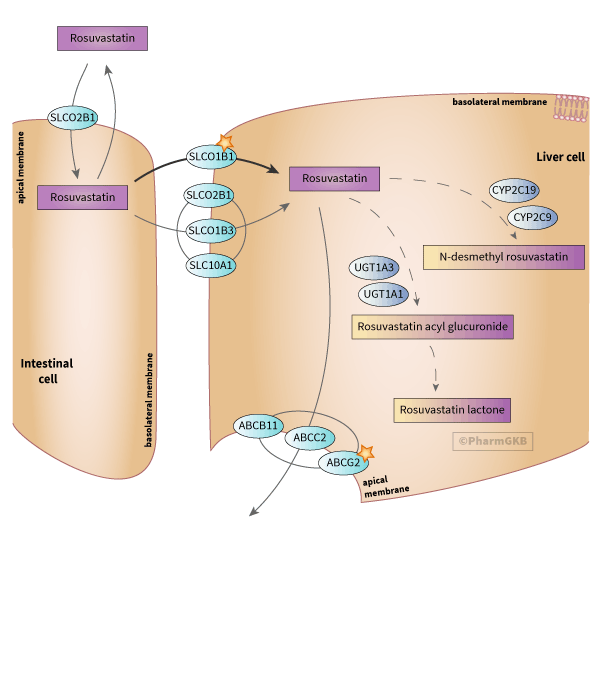
Rosuvastatin is not extensively metabolized, with only 10% of a radiolabeled dose recovered as metabolite [Article:14693307]. Greater than 90% of active plasma HMG-CoA reductase inhibitory activity is accounted for by the parent compound. Rosuvastatin can be metabolized to multiple metabolites including rosuvastatin-5S-lactone, N-desmethyl rosuvastatin and rosuvastatin acyl glucuronide, potentially mediated by CYP2C9, CYP2C19 and the glucuronosyltransferases (UGTs) [Article:27128002], [Article:14693307], [Article:27128002].
Transport
Rosuvastatin is a substrate of OATP1B1 (encoded by SLCO1B1), OATP1B3 (encoded by SLCO1B3) and SLCO2B1 transporters [Article:18617601]. It’s also transported by efflux transporters ABCG2, ABCC2 and ABCB11 [Articles:18617601, 16415124]. Genetic variations in the SLCO1B1 and ABCG2 genes have been linked to increased plasma concentration of rosuvastatin. Multiple clinical studies showed that SLCO1B1 rs4149056 (521T>C) C allele is associated with increased AUC and Cmax for rosuvastatin [Article:17568401], [Articles:25006781, 25673568, 23930675]. Rosuvastatin exposure (AUC) was also higher in those with the ABCG2 rs2231142 c.421AA genotype than the c.421CC genotype. Based on the observed increase in exposure, the risk for myopathy may also be increased. However, the association with risk of statin-related muscle toxicity has been inconsistent [Articles:23708174, 20347093, 29950617, 28812116, 30595243].
Reactions & interactions (18)
-
Biochemical Reaction
rosuvastatin → rosuvastatin acyl glucuronide
-
Biochemical Reaction
rosuvastatin → n-desmethyl rosuvastatin
-
Biochemical Reaction
rosuvastatin acyl glucuronide → rosuvastatin lactone
-
Catalysis
SLCO2B1 → Transport
-
Catalysis
ABCB11 → Transport
-
Catalysis
ABCG2 → Transport
-
Catalysis
ABCC2 → Transport
-
Catalysis
UGT1A3 → Biochemical Reaction
-
Catalysis
UGT1A1 → Biochemical Reaction
-
Catalysis
CYP2C9 → Biochemical Reaction
-
Catalysis
CYP2C19 → Biochemical Reaction
-
Catalysis
SLCO1B1 → Transport
-
Catalysis
SLC10A1 → Transport
-
Catalysis
SLCO2B1 → Transport
-
Catalysis
SLCO1B3 → Transport
-
Transport
rosuvastatin → rosuvastatin
-
Transport
rosuvastatin → rosuvastatin
-
Transport
rosuvastatin → rosuvastatin
Edit history (5)
- 2006-03-08 Create
- 2011-03-31 Update
- 2021-08-11 Update Updated gpml and figure with new candidates and specific metabolites.
- 2021-08-17 Update Added acyl glucuronide step in formation of lactone. Updated gpml, figure and image file.
- 2022-02-20 Update Pathway updated to include specific metabolites, new gpml, new figure and text.