About this pathway
Background
Fluvastatin is an HMG-CoA reductase inhibitor (statin) used to lower the blood levels of low-density lipoprotein (LDL) and total cholesterol and to slow the progression of atherosclerosis and reduce the risk of undergoing revascularization procedures in patients with CHD. It inhibits endogenous cholesterol production by competitive inhibition of 3-hydroxy-3-methylglutaryl coenzyme A reductase (HMGCR), the enzyme that catalyzes conversion of HMG-CoA to mevalonate depicted in the Statin Pathway, Pharmacodynamics.
Guidelines regarding the use of pharmacogenomic information in dosing for rosuvastatin were published by drug label and professional societies such as Clinical Pharmacogenetic Implementation Consortium (CPIC). Patients with reduced SLCO1B1 function or reduced CYP2C9 function may be at an increased risk of experiencing statin-induced myopathy when treated with fluvastatin. CPIC recommends a reduction in the starting dose for these patients. If higher doses are required for desired efficacy, an alternative statin should be considered. The Dutch Pharmacogenetics Working Group (DPWG) has evaluated therapeutic dose recommendations for fluvastatin based on SLCO1B1 genotypes. They conclude for SLCO1B1 521TC or 521CC and fluvastatine that no action is required for this gene-drug interaction. “The gene variation increases the plasma concentration of fluvastatin, but there is insufficient evidence to prove an effect on efficacy or side effects.”
Metabolism
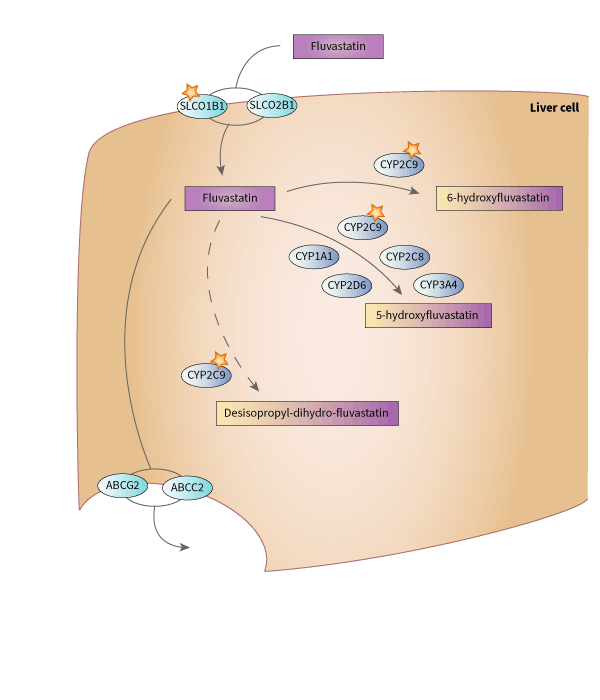
Fluvastatin is a lipophilic statin and almost exclusively eliminated via metabolism [Article:17178259]. It undergoes hydroxylation at the 5- and 6-position and N-deisopropylation with the 6 hydroxy being the most abundant [Article:10064574]. In vitro experiments with recombinant proteins, microsomes and inhibitors demonstrated CYP2C9 is the main metabolizing enzyme and can generate all three of the main metabolites [Article:10064574]. Other enzymes were capable of generating 5-hydroxy but at lower efficiency [Article:10064574]. Fluvastatin is a racemic mixture of two enantiomers 3R,5S‐fluvastatin and 3S,5R‐fluvastatin and there is evidence the enantiomers have slightly different PGx [Article:30989645]. 3R,5S‐fluvastatin is 30 times more active than 3S,5R‐fluvastatin [Article:30989645].
Genetic variations in the CYP2C9 (*2, *3) are associated with increased exposure to fluvastatin [Articles:30989645, 22941809, 32373204, 19663817]. The AUC of fluvastatin was 25% and 75% greater per copy of the CYP2C9*2 and CYP2C9*3 variant allele, respectively, with CYP2C9*3 has a larger effect than CYP2C9*2. Additionally, CYP2C9*2 and CYP2C9*3 alleles are associated with increased risk of fluvastatin-induced adverse effects, including liver and statin-related muscle toxicity ([Article:24024895]). Genetic variation in CYP2C9 has not been to be associated with fluvastatin lipid-lowering response [Articles:30363031, 12891229]). SLCO1B1 genotype may has an enantiospecific effect on active 3R,5S‐fluvastatin pharmacokinetics, with rs4149056 (c.521T>C) associated with increased AUC of active 3R,5S‐fluvastatin only [Article:30989645].
Transport
Fluvastatin is a substrate of the hepatic transporters, SLCO1B1 and SLCO2B1 [Articles:16714062, 15616150, 24799396]. It is also identified as a substrate of the efflux transporter ABCB1, ABCC2 and ABCG2 [Articles:30989645, 16198652, 15548849].
Reactions & interactions (16)
-
Biochemical Reaction
fluvastatin → 6-hydroxyfluvastatin
-
Biochemical Reaction
fluvastatin → 5-hydroxyfluvastatin
-
Biochemical Reaction
fluvastatin → desisopropyl-dihydro-fluvastatin
-
Catalysis
CYP2C9 → Biochemical Reaction
-
Catalysis
CYP3A4 → Biochemical Reaction
-
Catalysis
CYP2C9 → Biochemical Reaction
-
Catalysis
CYP2D6 → Biochemical Reaction
-
Catalysis
CYP1A1 → Biochemical Reaction
-
Catalysis
CYP2C8 → Biochemical Reaction
-
Catalysis
CYP2C9 → Biochemical Reaction
-
Catalysis
ABCC2 → Transport
-
Catalysis
ABCG2 → Transport
-
Catalysis
SLCO1B1 → Transport
-
Catalysis
SLCO2B1 → Transport
-
Transport
fluvastatin → fluvastatin
-
Transport
fluvastatin → fluvastatin
Edit history (6)
- 2006-03-08 Create
- 2011-03-31 Update
- 2022-02-03 Update Updated gpml and illustrator to include specific metabolites and remove papers that did not specify fluvastatin.
- 2022-02-20 Update Pathway updated to include specific metabolites, new gpml, new figure and text.
- 2022-02-20 Update Linked related statin pathways.
- 2024-05-07 Update Added star to SLCO1B1 (was already on CYP2C9) to indicate significance.