About this pathway
Background
Atorvastatin is an HMG-CoA reductase inhibitor or statin used to lower the blood levels of low-density lipoprotein (LDL) and total cholesterol as well as to lower the risk of stroke, heart attack, or other cardiac complications in patients with cardiovascular disease risk factors. It inhibits endogenous cholesterol production by competitive inhibition of HMG-CoA reductase (HMGCR), the enzyme that catalyzes conversion of HMG-CoA to mevalonate depicted in the Statin Pathway, Pharmacodynamics.
Guidelines regarding the use of pharmacogenomic information in dosing for atorvastatin were published by professional societies such as Clinical Pharmacogenetic Implementation Consortium (CPIC) and the Dutch Pharmacogenetics Working Group (DPWG). CPIC recommends reduced atorvastatin starting dose for patients with SLCO1B1 poor or decreased function phenotype, and warns possible increased risk for myopathy especially over 40mg dose. DPWG recommends choosing an alternative for patients with the SLCO1B1 521 CC or TC (rs4149056) genotype and with additional significant risk factors for statin-induced myopathy.
Metabolism
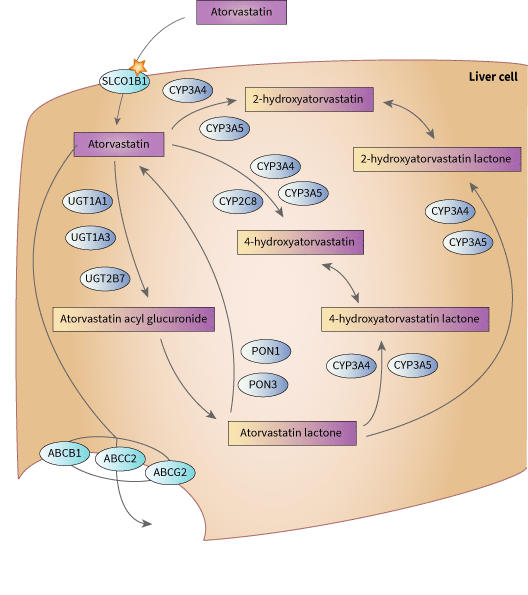
Atorvastatin is administered in an active form (atorvastatin acid) and is extensively metabolized to ortho-and parahydroxylated derivatives and various beta-oxidation products. CYP3A4/5 plays an important role in atorvastatin metabolism ([Articles:32128760, 14531725]). Atorvastatin and its metabolites also undergo glucuronidation mediated by UGT1A1, UGT1A3 and UGT2B7 [Articles:32128760, 16388406, 15801541, 11950779].
Transport
Atorvastatin is a substrate of the hepatic transporters, OATP1B1 (encoded by SLCO1B1) [Articles:16714062, 15616150, 24799396]). It is also identified as a substrate of the efflux transporter ABCB1, ABCC2 and ABCG2 [Articles:34659336, 26086347, 19474787, 16714062, 15616150], which may limit the intestinal absorption and biliary clearance of atorvastatin.
Genetic variations in the SLCO1B1 gene have been linked to increased plasma concentration of atorvastatin. Carriers of the rs4149056 C allele had much greater plasma concentration of atorvastatin than in carriers of the TT genotype [Articles:17473846, 20040338, 31594719, 29442027]. The increased exposure may also lead to increased risk of statin-related muscle symptoms ([Article:20347093], [Articles:21928084, 30569848, 32453264, 30250148, 26086347]. ABCG2 variant rs2231142 (421C>A) has been shown to be associated with atorvastatin exposure [Articles:25673568, 23876492, 31594719, 27787353]. The evidence for association of ABCG2 genetic variants with atorvastatin response or toxicity is considered weak because of small sample sizes or variation in results among studies [Articles:27296832, 26086347, 28833323]. Additionally, even though variations in CYP3A4/5 are not shown to predict myopathy while on atorvastatin, they may affect the severity of myotoxicity, however, the effect size was modest [Article:15900215].
Reactions & interactions (29)
-
Biochemical Reaction
atorvastatin lactone → 2-hydroxyatorvastatin lactone
-
Biochemical Reaction
atorvastatin lactone → 4-hydroxyatorvastatin lactone
-
Biochemical Reaction
4-hydroxyatorvastatin → 4-hydroxyatorvastatin lactone
-
Biochemical Reaction
atorvastatin → 2-hydroxyatorvastatin
-
Biochemical Reaction
atorvastatin → 4-hydroxyatorvastatin
-
Biochemical Reaction
2-hydroxyatorvastatin → 2-hydroxyatorvastatin lactone
-
Biochemical Reaction
atorvastatin lactone → atorvastatin
-
Biochemical Reaction
atorvastatin acyl glucuronide → atorvastatin lactone
-
Biochemical Reaction
atorvastatin → atorvastatin acyl glucuronide
-
Catalysis
CYP3A4 → Biochemical Reaction
-
Catalysis
CYP3A5 → Biochemical Reaction
-
Catalysis
CYP3A4 → Biochemical Reaction
-
Catalysis
CYP3A5 → Biochemical Reaction
-
Catalysis
CYP3A4 → Biochemical Reaction
-
Catalysis
CYP3A5 → Biochemical Reaction
-
Catalysis
CYP3A4 → Biochemical Reaction
-
Catalysis
CYP3A5 → Biochemical Reaction
-
Catalysis
CYP2C8 → Biochemical Reaction
-
Catalysis
PON1 → Biochemical Reaction
-
Catalysis
PON3 → Biochemical Reaction
-
Catalysis
SLCO1B1 → Transport
-
Catalysis
UGT1A3 → Biochemical Reaction
-
Catalysis
UGT1A1 → Biochemical Reaction
-
Catalysis
UGT2B7 → Biochemical Reaction
-
Catalysis
ABCC2 → Transport
-
Catalysis
ABCG2 → Transport
-
Catalysis
ABCB1 → Transport
-
Transport
atorvastatin → atorvastatin
-
Transport
atorvastatin → atorvastatin
Edit history (5)
- 2006-03-08 Create
- 2011-04-11 Update
- 2022-02-03 Update Updated image file and image map
- 2022-02-20 Update Pathway updated to be specific for atorvastatin and its metabolites, new gpml, new figure and text.
- 2022-02-20 Update Linked related statin pathways.