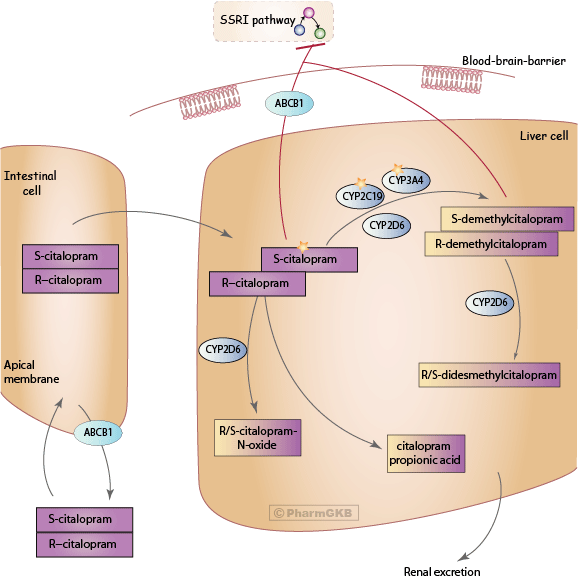
About this pathway
Depression, anxiety disorders, and dementia-related behavioral disturbances have been linked to the dysfunction of serotonergic neurotransmission [Article:11336616].
Citalopram is a selective serotonin reuptake inhibitor (SSRI). The molecular target for SSRIs is SLC6A4, resulting in an inhibition of serotonin reuptake from the synaptic cleft as seen in the SSRI pathway.
Following oral administration, citalopram is rapidly absorbed, with peak plasma levels observed approximately after 1- 4 hours and a plasma half-life of approximately 35 hours after administration [Articles:729609, 6939299, 17722014]. As a substituted phthalane derivative with a tertiary amino acid side chain, citalopram is a highly lipophilic compound and has one chiral center [Article:10507507]. Due to its high lipophilicity, citalopram has a high bioavailability of approximately 80% after oral administration [Article:17722014]. Approximately 12 to 23% of an oral dose of citalopram is excreted as unchanged citalopram in the urine, and approximately 10% is excreted in the feces [Article:8732438].
Citalopram and its N-demethylated metabolites exist as racemic compounds. In vitro and in vivo tests showed that the effects of citalopram and N-demethylcitalopram are mainly-or solely- due to the S-enantiomers: S-citalopram and S-demethylcitalopram [Article:1632943]. In their in vitro inhibition of serotonin uptake, S-citalopram and S-demethylcitalopram are 167 and 6.6 times more potent, respectively, than the R-enantiomers [Article:1632943]. Compared to citalopram , demethylcitalopram crosses the blood-brain barrier poorly [Article:9571301].
S-citalopram is the active ingredient of escitalopram, another available SSRI [Article:17426664]. To a certain degree, R-citalopram counteracts the serotonin-enhancing action of the S-citalopram enantiomer [Article:16918708]. As a result, escitalopram is a more potent antidepressant than citalopram, as the latter is a mixture of S-citalopram and R-citalopram.
Both enantimors of citalopram are metabolized by the hepatic cytochrome P450 system. The formation of R/S-demethylcitalopram is catalized by the isoenzymes CYP2C19, CYP3A4, and CYP2D6 [Articles:10507506, 10494454]. The subsequent N-demethylation to R/S-didesmethylcitalopram is mediated by CYP2D6 [Articles:9110356, 10575324, 7581865]. Clearance of R/S-citalopram is stereoselective [Articles:8986013, 17722014, 9366029]. In in vitro studies in human liver microsomes, CYP2C19, CYP3A4, and CYP2D6 all favor the conversion of the biologically active S-enantiomer [Articles:10575324, 17722014]. Administration of the racemic compounds produces different steady-state concentrations of the R- and S-stereoisomers. Further, N-oxidation and deamination have also been observed and lead to R/S-citalopram N-oxide and citalopram propionic acid metabolites, respectively [Articles:16470634, 9698084]. The N-oxidation step is also mediated by CYP2D6 [Article:10575324].
According to in vitro and in vivo studies, citalopram and escitalopram appear to have minimal effects on major CYP enzymes [Articles:10507506, 12387707] Citalopram is a weak CYP2D6 inhibitor and has weak or no effects on CYP1A2, CYP2C19, and CYP3A4 [Article:18691982]. Demethylcitalopram is a one order of magnitude more potent inhibitor of CYP2D6 than citalopram and may mediate the mild interaction of the drug with other drugs metabolized by this isoenzyme [Article:9571301].
Several publications show that the plasma concentration of citalopram is affected by CYP2C19 variants. Poor metabolizers of CYP2C19 had a reduced clearance of citalopram [Articles:16418702, 17625515, 12968986, 8451774, 12975335, 16855453]. Patients with ultrarapid CYP2C19 alleles had a lower serum concentration of S-citalopram [Article:17625515]. There is evidence that the CYP2D6 poor metabolizer genotype in combination with CYP2C19 poor metabolizer genotype can increase citalopram¿s half-life; in one patient, this resulted in severe adverse effects [Article:2968986]. In another study, 6 out of 7 non-responders to citalopram were genotyped as extensive metabolizers for CYP2D6 and CYP2C19 [Article:8986013]. As these studies clearly indicate, the pharmacokinetics of citalopram is affected by CYP2D6 and CYP2C19 genotypes, but the clinically relevant effect greatly varies between studies [Articles:16855453, 18382661].
Citalopram is an ABCB1 substrate and is actively transported by that protein from the brain. The efficacy of citalopram in people possessing the 2677TT (rs2032583) genotype of ABCB1 is likely to be diminished [Articles:18215618, 18940259], although another study did not confirm this result [Article:18382661].
Reactions & interactions (15)
-
Biochemical Reaction
citalopram → demethylcitalopram
-
Biochemical Reaction
citalopram → citalopram propionic acid
-
Biochemical Reaction
citalopram → citalopram-n-oxide
-
Biochemical Reaction
demethylcitalopram → didesmethylcitalopram
-
Catalysis
CYP2D6 → Biochemical Reaction
-
Catalysis
CYP2C19 → Biochemical Reaction
-
Catalysis
CYP3A4 → Biochemical Reaction
-
Catalysis
ABCB1 → Transport
-
Catalysis
ABCB1 → Transport
-
Catalysis
CYP2D6 → Biochemical Reaction
-
Catalysis
CYP2D6 → Biochemical Reaction
-
Leads To
escitalopram → citalopram
-
Leads To
citalopram → Selective Serotonin Reuptake Inhibitor Pathway, Pharmacodynamics
-
Transport
citalopram → citalopram
-
Transport
citalopram → citalopram
Edit history (3)
- 2009-03-05 Create
- 2011-04-11 Update
- 2021-09-17 Update Updated gpml to include links to escitalopram. Updated title to include escitalopram. Updated cell ontology terms.