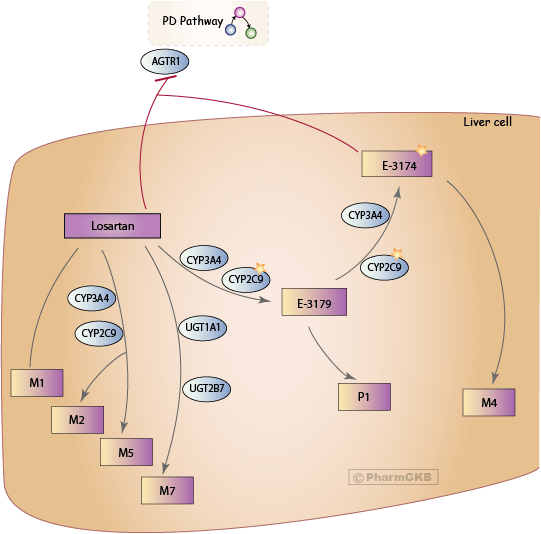
About this pathway
Altering activity in the renin-angiotensin-aldosterone axes is central in the treatment of hypertension. Compounds which have been employed in this regard are renin inhibitors, ACE inhibitors, and, more recently, angiotensin II receptor antagonists.
Losartan, the first orally available angiotensin II receptor antagonist, is an active nonpeptide, selective, and competitive angiotensin II receptor, type 1 (AGTR1) antagonist without agonist properties [Articles:16029066, 15991937].
Losartan is rapidly and almost completely absorbed, and reaches maximum concentrations 1-2 hours after oral administration [Article:16029066]. The reported bioavailability of losartan is around 35%, probably due to variable first-pass metabolism [Article:8529329]. Losartan and its pharmacologically active metabolite E 3174 have a relatively low volume of distribution [Article:8529329], consistent with the high protein binding of these acidic compounds, primarily to albumin [Article:7657853].
After oral administration, approximately 14% of the losartan dose is converted to E-3174 [Article:8529329]. The E-3174 metabolite is at least 10-fold more potent than losartan (non-competitive inhibition of the AGTR1) [Articles:7736913, 7736926, 15991937]. The terminal elimination half-life of losartan ranges from 1.5 to 2.5 hours and that of E-3174 from 6 to 9 hours [Articles:8529329, 10424320].
The E-3174 metabolite is largely responsible for the duration of action of losartan [Articles:10096267, 8385175]. For intact losartan, renal excretion is a minor elimination pathway (12% of clearance of losartan), but for the E-3174 metabolite, renal excretion is a major pathway (55% of its clearance) [Article:8529329].
The metabolism of losartan involves three main routes: oxidation, hydroxylation, and glucuronidation. The conversion of losartan to E-3174 is an oxidation of an alcohol to a carboxylic acid. This biotransformation is catalyzed by cytochrome P450 enzymes with E-3179 as an aldehyde intermediate. Alternatively, the E-3179 intermediate can also be hydroxylated to the inactive metabolite P1 [Article:7736913]. Furthermore, in vitro studies with fresh human liver slices showed that, in addition to E-3174 (M6), the extensively metabolized losartan produced five other minor metabolites, which exhibit much less activity than the parent compound (M1, M2, M4, M5, M7) [Articles:1352222, 7736913]. Another study investigating the glucuronidation of losartan with recombinant human UGTs in human liver microsomes identified UGT1A1 and UGT2B7 as the main contributors to the production of tetrazole-N2-glucuronide (M7) from losartan [Article:18674515].
In vitro studies and in vivo studies have demonstrated that losartan is metabolized by CYP3A4 and CYP2C9 to E-3174 [Articles:7736913, 7736926, 10096267, 10197301, 9551703]. The results of the in vitro studies using isoform-selective inhibitors, recombinant human liver CYPs, and isoform-specific antibodies suggested that CYP3A4 has a significant role in the formation of E3174 [Articles:7736913, 7736926]. In these experiments in human liver preparations, the combination of sulfaphenazole and ketoconazole has produced the greatest inhibition of losartan biotransformation to E-3174 (97%) [Article:7736913]. A later in vitro analysis of losartan oxidation using yeast and human liver microsomes found that at physiological concentrations, CYP2C9 is the dominant isoenzyme and CYP3A4 is relevant in losartan clearance only at higher drug concentrations [Article:11408373]. The information gained from in vivo studies also emphasizes the prominent role of CYP2C9 [Articles:10096267, 9542475, 9551703]. CYP3A4 inhibitors ketoconazole, erythromycin, and itraconazole have yielded non-significant differences in the AUC and half-life time of losartan in different human studies [Articles:9542475, 9551703]. On the other hand, an investigation on the effects of the CYP2C9 inhibitor fluvastatin on losartan pharmacokinetics in healthy volunteers concluded that possibly both CYP3A4 and CYP2C9 pathways need to be inhibited concurrently to cause a significant change [10197301]. A study with extensive or poor metabolizers of debrisoquine [CYP2D6] or mephenytoin [CYP2C19] suggests that neither CYPs are involved to any major extent in the in vivo conversion of losartan to E3174 [Article:10424320].
Losartan is often used as a CYP2C9 probe drug. The effect of genomic variability in CYP2C9 on losartan metabolism was investigated in a number of studies. The rate of losartan oxidation is reduced in liver microsomes from individuals hetero- or homozygous for the CYP2C9*3 (rs1057910) allele, or homozygous for the CYP2C9*2 (rs1799853) allele [Article:11408373]. The results are consistent with a studies that describe a minimal or reduced conversion of losartan to E-3174 in a subject homozygous for CYP2C9*3 allele [Articles:10096267, 21841812]. While the CYP2C9*3 variant allele is associated with decreased formation of the E-3174 metabolite, the CYP2C9*2 allele shows less impact on enzyme function [Articles:11823761, 15197523, 14504849]. Besides the well established reduced function alleles, the CYP2C9*13 (rs72558187) is associate with reduced conversion of losartan to E-3174 comparable to CYP2C9*3 in Chinese subjects heterozygous for either one of the variant alleles [Article:19604036].
Most studies focus on the effect of CYP2C9 variation only on the losartan pharmacokinetic in healthy volunteers. A therapeutic impact is studied for the CYP2C9*30 (A477T) allele, which might be associated with diminished response to the antihypertensive effect of losartan as reported in two Japanese hypertensive patients carrying CYP2C9*30, while carrying the CYP2C9*3 allele seemed to have no effect on the antihypertensive response [Article:18971529]. CYP2C9*2 and CYP2C9*3 alleles do not influence the antihypertensive effect of losartan in Finish men with essential hypertension and normal kidney function [Article:19593208]. Variants in CYP2C9 (*2,*3) may be at least partially responsible for the less than optimal antiproteinuric effects in patients with chronic kidney disease receiving losartan therapy [Article:19669737].
All studies agree that further investigations, involving larger numbers of subjects (hypertensive patients) with different genotypes, are needed to evaluate the impact of genetic variation on an impaired therapeutic response to the drug. With this regard, a paper on the conceptual basis and methodology for a study of the pharmacogenomics of losartan response in Italian hypertensive patients (n=800) was recently published, in which CYP2C9 SNPs are one of the proposed aspects to investigate [Article:18034615].
Several studies on the effect of CYP isoenzyme inhibitors/inducers on the concentration of losartan and E-3174 were conducted [Articles:9357393, 9551703, 9542475, 8751032, 12235444, 8653989, 11477318]. The percentage change in the E-3174 formation that would result in a pharmacodynamically relevant effect on blood pressure is unclear at this point [Article:16029066]. No significant drug-drug pharmacokinetic interactions have been found in interaction studies with hydrochlorothiazide, digoxin, and warfarin [Articles:8750372, 8703664, 8568008].
Edit history (3)
- 2009-02-26 Create
- 2012-01-10 Update
- 2024-05-23 Update fixed typo