About this pathway
The primary use of tricyclic antidepressants (TCAs) for treatment of depression has decreased with the introduction of the selective serotonin reuptake inhibitors (SSRIs) [Article:10319193]. The SSRIs have a more tolerable adverse-effect profile and decreased risk for toxicity [Article:16553509]. But the TCAs remain an effective therapeutic option for certain types of depressive illnesses, such as major depression with melancholic features and post-stroke depression [Articles:8835647, 12893112]. The TCAs also have been recognized as beneficial treatment for fibromyalgia, neuropathic pain, and migraine prophylaxis [Articles:11029681, 12230591, 15336464]. Desipramine appears to be effective in the treatment of adult attention-deficit/hyperactivity disorder [Article:16732717].
After oral administration, TCAs are rapidly absorbed. TCAs are lipophilic compounds and therefore exhibit a large volume of distribution. They bind to plasma albumin and also to extravascular tissues [Article:10319193]. TCAs reach a peak plasma concentration within 2-6 hours. They are subjected to extensive hepatic metabolism by P450 isoenzymes and less than 5% of a TCA dose is eliminated unchanged [Article:10319193].
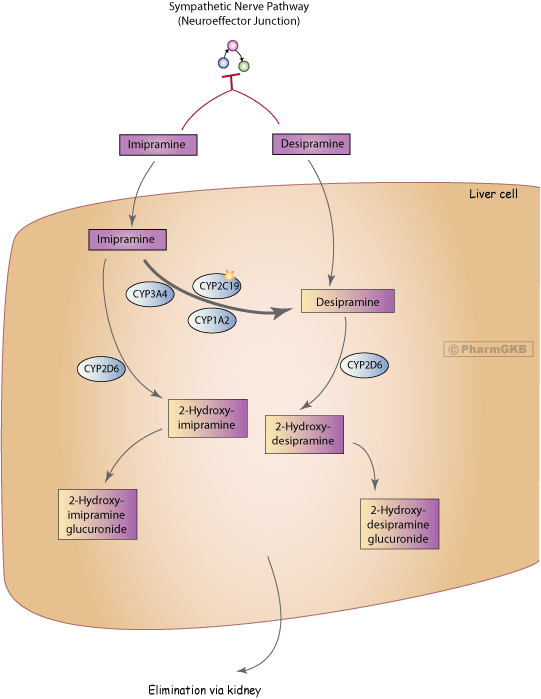
CYP2C19 activity is associated with the N-demethylation of tertiary amine TCA. P450 isoenzymes CYP1A2 and CYP3A4 also participate in tricyclic demethylation [Articles:10319902, 9084901, 17471183]. The tertiary amine imipramine is typically metabolized by demethylation to the secondary active metabolite desipramine. Desipramine is also a tricyclic drug by itself. Both tertiary and secondary amines are metabolized, mainly through hydroxylation by CYP2D6, to 2-OH- imipramine and 2-OH-desipramine [Articles:10319193, 16553509]. Hydoxy-metabolites of TCAs have similar or shorter half-lives and smaller distribution volumes than their parent compounds [Articles:7461025, 2687861]. Glucuronide conjugation of TCA hydroxylated metabolites improves their water solubility and therefore promotes more efficient renal excretion. However, hydroxy metabolites are also cleared into urine in their unconjugated form [Article:2116227]. Commonly, the clearance of TCAs is observed to be proportional to the drug concentration, but some studies showed a saturation of the P450 hydroxylation with dose-dependent kinetics at high doses of imipramine and desipramine [Articles:1813901, 10319193, 3709631, 6467794, 2687860].
The dose range of many tricyclic antidepressants is between 25 - 300 mg/day. Genetically-based differences in the activity of CYP2C19 and CYP2D6 account in large part for the wide interindividual variability in the drugs metabolism and plasma concentration [Article:10319193]. Depending on the antidepressant, CYP2C19 poor metabolizers, as well as CYP2D6 poor metabolizers, may generate plasma drug levels several fold higher during routine dosing [Articles:15037866, 16384813]. Toxic effects, like agitation, confusion, and pacing, are seen in patients with TCA plasma concentrations greater than 450-500ng/ml [Article:9139291]. Major toxicity and death is associated with concentrations above 1000ng/ml [Articles:17471183, 9139291]. In terms of drug interactions, desipramine is not a strong inhibitor of CYP2D6, but imipramine significantly inhibits CYP2C19 and CYP1A2 [Article:17471183].
Edit history (1)
- 2008-10-08 Create