About this pathway
Nicotine is an alkaloid found in tobacco plants. It is a substance that acts as a stimulant in humans and is one of the main factors responsible for tobacco dependence. When nicotine enters the body, it is distributed quickly through the bloodstream, and it can cross the blood-brain barrier to enter the central nervous system (CNS). It binds to two main types of nicotinic acetylcholine receptors: the ganglion type and the CNS type.
In chromaffin cells in the adrenal medulla, nicotine binds to the ganglion-type nicotinic acetylcholine receptor, which is composed of alpha 3 (CHRNA3) and beta 4 (CHRNB4) subunits. By binding to the receptors, nicotine causes cell depolarization and an influx of calcium through voltage dependent calcium channels. Calcium triggers the release of epinephrine from the chromaffin vesicles into the bloodstream, which leads to increased heart rate and blood pressure and elevation of blood glucose level.
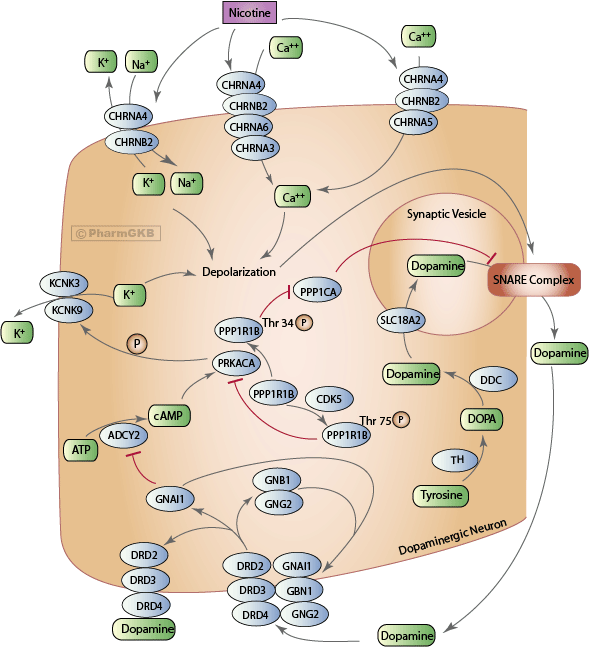
In dopaminergic neurons in the CNS, nicotine binds to the CNS-type nicotinic acetylcholine receptors. The main type of CNS receptor is composed of alpha 4 beta 2 (CHRNA4, CHRNB2) subunits. It has been shown that alpha 6, alpha 5, and beta 3 can also be in the receptor complex to modulate binding sensitivity. By binding to the receptor, nicotine causes cell depolarization and release of dopamine from the cell through the SNARE complex. Dopamine then binds to dopamine receptors (DRD2, DRD3, DRD4) on dopaminergic terminals and activates Gi alpha (GNAI1), initiating a feedback loop to inhibit dopamine release. One of the key players mediating dopamine signaling is PPP1R1B (also called DARPP-32, dopamine and cyclic AMP-regulated phospho-protein). PPP1R1B is a bifunctional signal transduction molecule which, by distinct mechanisms, inhibits either a serine/threonine kinase (PPKACA or PKA) or a serine/threonine phosphatase (PPP1CA or protein phosphatase 1). When PPP1R1B is phosphorylated by PPKACA at threonine 34, it is an inhibitor of protein phosphatase 1 (PPP1CA), which inhibits dopamine secretion through the SNARE complex. When PPP1R1B is phosphorylated by CDK5 at threonine 75, it is converted to an inhibitor of PPKACA. Binding of dopamine to D2-like dopamine receptors leads to inhibition of adenylate cyclase (ADCY2) via G-protein GNAI1, and decreases PKA-stimulated phosphorylation of DARPP-32 at Thr34. This, in turn, relieves the inhibition of protein phosphatase 1 (PPP1CA), and inhibits further dopamine release.
Edit history (1)
- 2008-09-12 Create