About this pathway
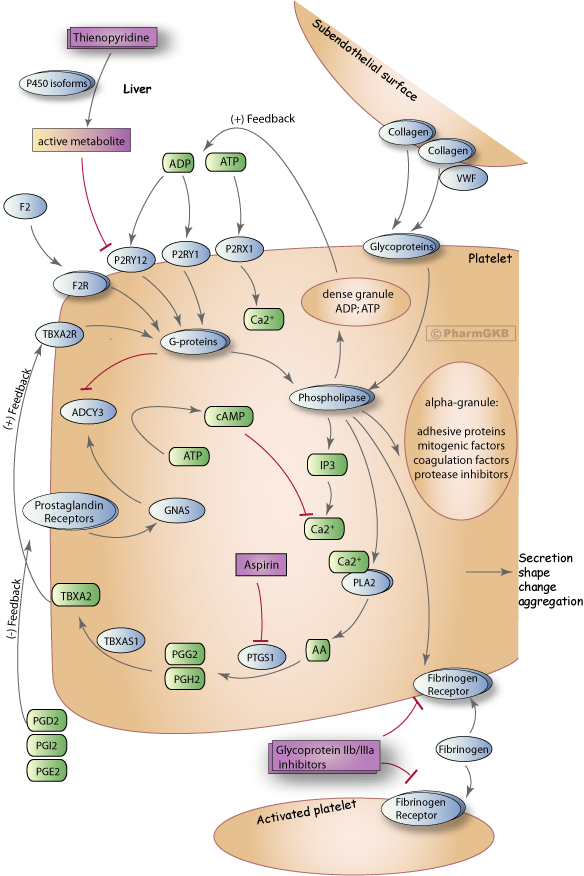
Platelet activation and coagulation normally do not occur within an intact blood vessel. After vessel wall injury, platelet-plug formation is initiated by the adherence of platelets to subendothelial collagen. In high shear arterial blood, platelets are first slowed down from their blood flow velocity by interacting with the collagen-bound von Willebrand factor (VWF) and subsequently stopped by binding directly to collagen via their glycoprotein receptor complex. The activation of these collagen receptors on platelets following their binding to collagen activates phospholipase C (PLC)-mediated cascades. This results in a mobilization of calcium from the dense tubula system. An increase in intracellular calcium is associated with activation of several kinases necessary for morphological change, the presentation of the procoagulant surface, the secretion of platelet granular content, the activation of glycoproteins, and the activation of Phospholipase A2 (PLA2). Activation of PLA2 releases arachidonic acid (AA), which is a precursor for TBXA2 synthesis. PTGS1 catalyzes the first step in the formation of TBXA2 from AA. This reaction is irreversibly blocked by aspirin, which also leads to the blockage of platelet aggregation
These processes result in the local accumulation of molecules like thrombin, TBXA2, and ADP, which are important for the further recruitment of platelets as well as the amplification of activation signals as described above. The secreted agonists activate their respective G protein coupled receptors: thrombin receptor (F2R), thromboxane A2 receptor (TBXA2R), and ADP receptors (P2RY1 and P2RY12). The P2RY12 receptor couples to Gi, and when activated by ADP, inhibits adenylate cyclase. This interaction counteracts the stimulation of cAMP formation by endothelial-derived prostaglandins, which alleviates the inhibitory effect of cAMP on IP3-mediated calcium release. Thienopyridines, a class of oral antiplatelet agents, permanently inhibit P2RY12 signaling, which is sufficient to block platelet activation.
F2R, TBXA2R and P2RY1 couple to the Gq-PLC-IP3-Ca2+ pathway, inducing shape change and platelet aggregation. In addition, receptor signaling through G12/13 (F2R; TBXA2R) contributes to morphological changes through activation of kinases.
Platelet adhesion, cytoskeletal reorganization, secretion, and amplification loops are all different steps towards the formation of a platelet-plug. These cascades result in the activation of the Fibrinogen Receptor expressed on platelet cells. This activation develops binding sites for fibrinogen, which are not available in inactive platelets. The binding of fibrinogen results in the linkage of activated platelets through fibrinogen bridges, thereby mediating aggregation. Inhibition of this receptor through Glycoprotein IIb/IIIa inhibitors blocks platelet aggregation induced by any agonist.
Edit history (4)
- 2008-02-19 Create
- 2011-02-27 Update
- 2023-07-13 Update Added related pathways
- 2024-07-11 Update fixed typos