About this pathway
Clopidogrel, a thienopyridine derivative, binds specifically and irreversibly to the platelet P2RY12 purinergic receptor, inhibiting ADP-mediated platelet activation and aggregation [Article:11127873]; [Article:15199474].
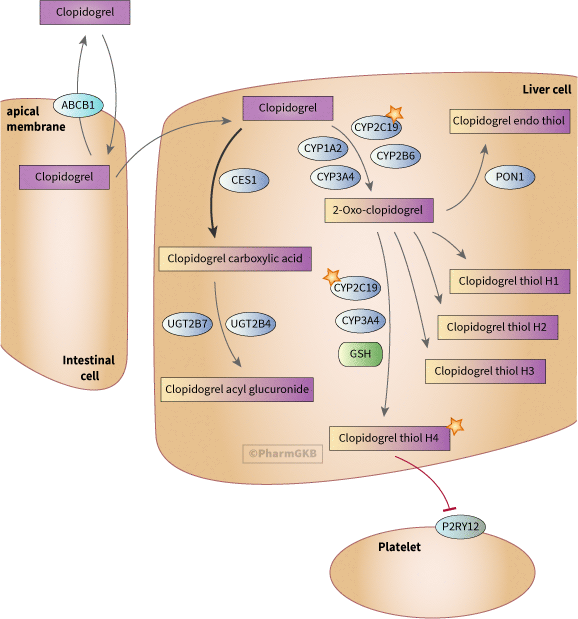
Following oral administration, clopidogrel is rapidly absorbed. Due to its extensive metabolism, clopidogrel is not detected in human plasma. Clopidogrel is a prodrug that is absorbed in the intestine [Article:10440420]; [Article:10440419] and activated in the liver [Article:1510701]. The conversion of clopidogrel to its active metabolite requires two sequential oxidative steps. As shown in Figure 1, the first step leads to formation of 2-oxo-clopidogrel, followed by the conversion of 2-oxo-clopidogrel to the active metabolite. CYP1A2, CYP2B6, CYP2C9, CYP2C19 and CYP3A4/5 are implicated as cytochrome P450 enzymes involved in the metabolism of clopidogrel. However, the relative importance of the individual enzymes and which part of the reaction they are involved in are controversial, as discussed in the literature. Savi et al. [Article:11127873] showed that clopidogrel was converted into 2-oxo-clopidogrel by P450 monooxygenase-dependent metabolism in vitro and that hydrolysis of 2-oxo-clopidogrel generates the active metabolite. Several publications indicate a major role for CYP3A4 [Article:17361128]; [Article:12485953]. Other in vitro studies showed that CYP1A2, CYP2B6, and CYP2C19 were capable of forming the 2-oxo form from clopidogrel in liver microsomes (Kurihara A et al. Drug Metab Rev 2005; 37: Suppl 2:99-99); [Article:19812348]. When 2-oxo- clopidogrel was used as a substrate, the enzymes CYP3A4, CYP2C9, CYP2C19, and CYP2B6 produced the active metabolite ; [Article:19812348]. The study by Kazui et al [Article:19812348] concluded that CYP2C19 contributes substantially to both oxidative steps and that CYP3A4 contributes to the second oxidative step. Paraoxonase 1 (PON1) is also shown to be involved in the transformation of clopidogrel [Article:21170047]. The metabolism of 2-oxo-clopidogrel results in cis- and trans-thiol diastereoisomeres H1 to H4 and an endo-thiol isomer [Articles:12386137, 21301779, 21900914], of which H4 was identified as the active isomer facilitating the antiplatelet response [Articles:21301779, 22374717]. CYP2C19 is the major enzyme found for the H4 formation and to a minor extent CYP3A4 is able to mediate H4 formation [Article:22374717]. However, PON1 is shown only to be involved in endo metabolite formation [Article:22374717].
In a competing metabolic reaction, about 85 % of the drug is hydrolyzed to an inactive carboxylic acid derivative by esterases [Article:10440420]; [Article:6943252]. The active metabolite of clopidogrel contains a thiol group which binds to a free cysteine on the P2RY12 receptor and irreversibly blocks ADP binding and receptor activation (Figure 1) [Article:11127873]. Once this blockage has occurred, platelets are affected for their entire lifespan of approximately 7-10 days.
Drug-drug interactions of clopidogrel were reported with atorvastatin [Article:12515739]; the calcium-channel antagonist verapamil [Article:19007592], and the proton-pump inhibitor omeprazole [Article:18206732]; [Article:19706858]; [Article:19761935]. The clinical implications of these findings are still under investigation [Article:19007593]; [Article:19635603]. Several clinical studies did not support the finding that atorvastatin can interfere with the effect of clopidogrel [Article:12925453]; [Article:17659194]; [Article:18440347].
Recent studies indicate that the pharmacodynamic response to clopidogrel is variable, with 20-40% of patients being classified as non-responders, poor-responders or resistant to clopidogrel because of low inhibition of ADP-induced platelet aggregation or activation [Article:17900275]. Nongenetic factors influencing the clopidogrel response include age, diabetes, renal failure, and cardiac failure [Article:18781853]. As described above, the prodrug clopidogrel requires activation in the liver. A growing number of studies investigated the effect of pharmacokinetic variables (intestinal absorption and metabolic activation) on response to clopidogrel. ABCB1 is involved in the intestinal absorption of clopidogrel. Two recent studies found an influence of the C3435T variant (rs1045642) in ABCB1 on clopidogrel absorption in patients with cardiovascular diseases [Article:17112805]; [Article:19106083]. A genome-wide association study of ADP-stimulated platelet aggregation in response to clopidogrel found no association between this single-nucleotide polymorphism (SNP) and clopidogrel response [Article:19706858].
CYP2C19 is one of the hepatic cytochrome P450 enzymes involved in the formation of clopidogrel's active metabolite. Genetic polymorphisms of CYP2C19 are associated with impaired clopidogrel metabolism in healthy volunteers and in patients [Article:17900275]; [Articles:16772608, 19106083, 18004210, 17681590, 19108880, 19106084]. This poor metabolizer phenotype has also been associated with an increased risk of cardiovascular events. The CYP2C19*2 genetic variant 681 G>A (rs4244285) was identified as a major determinant of prognosis in young patients who received clopidogrel treatment after myocardial infarction [Article:19108880]. Furthermore, patients carrying any two CYP2C19 loss-of-function alleles (*2, *3 (rs4986893), *4 (rs28399504), or *5 (rs56337013)) had a higher rate of cardiovascular events than patients who did not have these alleles [Article:19106083]. Similarly, another study showed that carriers of a reduced-function CYP2C19 allele had significantly lower levels of clopidogrels active metabolite, diminished platelet inhibition, and a higher rate of major adverse cardiovascular events [Article:19106084]. A genome-wide association analysis identified 13 SNPs on chromosome 10q24 within the CYP2C18-CYP2C19-CYP2C9-CYP2C8 cluster showing strong evidence for association with clopidogrel response in an Amish population. The SNP rs12777823 within this cluster was the most significantly associated variant. All 13 SNPs were in strong linkage disequilibrium with each other and also with the loss-of-function variant CYP2C19*2, which further findings showed accounted for most of all the association with diminished platelet response to clopidogrel. CYP2C19*3 and *5 were not polymorphic in the Amish population. The extension and replication of these results in a population with high risk of cardiovascular disease showed an association of CYP2C19*2 with poorer cardiovascular outcomes [Article:19706858].
Reactions & interactions (23)
-
Biochemical Reaction
clopidogrel → clopidogrel carboxylic acid
-
Biochemical Reaction
2-oxo-clopidogrel + glutathione → clopidogrel thiol metabolite H4
-
Biochemical Reaction
2-oxo-clopidogrel → clopidogrel thiol metabolite H3
-
Biochemical Reaction
clopidogrel → 2-oxo-clopidogrel
-
Biochemical Reaction
2-oxo-clopidogrel → clopidogrel endo-thiol
-
Biochemical Reaction
clopidogrel carboxylic acid → clopidogrel acyl glucuronide
-
Biochemical Reaction
2-oxo-clopidogrel → clopidogrel thiol metabolite H2
-
Catalysis
CES1 → Biochemical Reaction
-
Catalysis
CYP3A4 → Biochemical Reaction
-
Catalysis
CYP2C19 → Biochemical Reaction
-
Catalysis
ABCB1 → Transport
-
Catalysis
CYP2C19 → Biochemical Reaction
-
Catalysis
CYP2B6 → Biochemical Reaction
-
Catalysis
CYP1A2 → Biochemical Reaction
-
Catalysis
CYP2C19 → Biochemical Reaction
-
Catalysis
CYP3A4 → Biochemical Reaction
-
Catalysis
PON1 → Biochemical Reaction
-
Catalysis
UGT2B4 → Biochemical Reaction
-
Catalysis
UGT2B7 → Biochemical Reaction
-
Inhibition
clopidogrel thiol metabolite H4 → P2RY12
-
Transport
clopidogrel → clopidogrel
-
Transport
clopidogrel → clopidogrel
-
Transport
clopidogrel → clopidogrel
Edit history (5)
- 2009-03-12 Create
- 2011-03-15 Update
- 2018-01-08 Update Text updated to include details of active metabolite H4 and clarify role of PON1 and formation of endo-thiol
- 2019-03-18 Update Updated to new illustrator and gpml formatting.
- 2019-04-02 Update Added endo-thiol to gpml and figure.