About this pathway
Background
Diclofenac is a traditional NSAID, non-steroidal anti-inflammatory drug used in the treatment of arthritis [Article:19602986]. While it was not designed to selectively inhibit COX2 (coded for PTGS2) rather than COX1 (PTGS1), it shows greater inhibition of COX2 than COX1 at a level comparable to that of celecoxib, a designed COX2 inhibitor [Article:11496855]. As with other NSAIDs it carries a warning for cardiovascular events and upper gastrointestinal (GI) bleeding (see label). Diclofenac also carries a warning for rare hepatotoxicity that occurs in around 0.6% of users [Article:23128910].
Metabolism
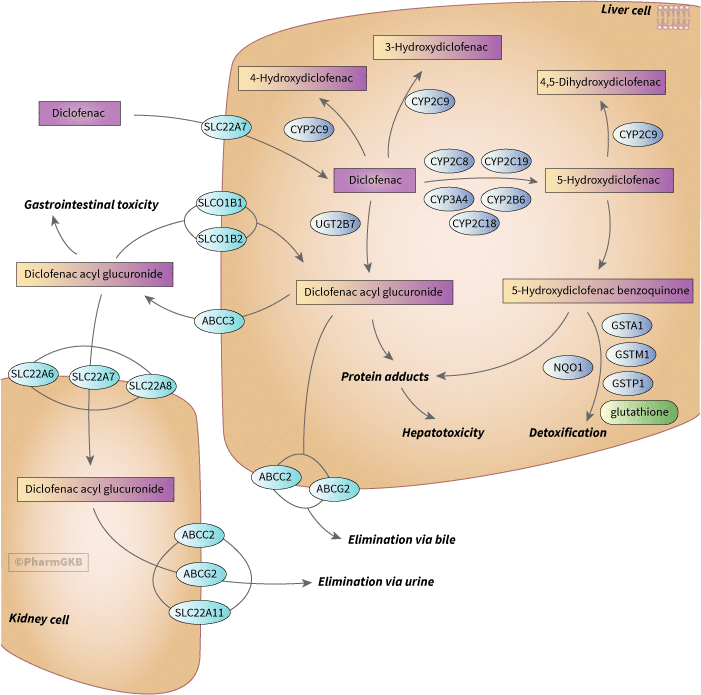
Metabolism of diclofenac occurs mainly by hydroxylation and glucuronidation [Article:24246759] The main hydroxylation product is 4 hydroxydiclofenac which is generated by CYP2C9 [Article:24246759].
Toxicity
In a systematic review of the risk for adverse cardiovascular events and NSAIDs, diclofenac was among the NSAIDs with the highest risk [Article:21980265]. In pairwise comparisons the risk was significantly higher than for celecoxib, ibuprofen and naproxen and not significantly different from rofecoxib, which was withdrawn from US market due to the cardiovascular risk [Article:21980265]. Another large review examining only patients with osteoarthritis and rheumatoid arthritis found diclofenac had a relative risk for major cardiovascular adverse events that was similar to celecoxib, ibuprofen and naproxen but had better efficacy for pain (as measured by pain global assessment) [Article:25879879]. In this population, the risks of diclofenac for GI adverse events were lower than ibuprofen and naproxen and comparable to celecoxib [Article:25879879].
Reactions & interactions (40)
-
Biochemical Reaction
diclofenac → diclofenac acyl glucuronide
-
Biochemical Reaction
5-hydroxydiclofenac → 4',5-dihydroxydiclofenac
-
Biochemical Reaction
diclofenac → 4'-hydroxydiclofenac
-
Biochemical Reaction
5-hydroxydiclofenac → 5-hydroxy diclofenac benzoquinone
-
Biochemical Reaction
diclofenac → 5-hydroxydiclofenac
-
Biochemical Reaction
diclofenac → 3'-hydroxydiclofenac
-
Catalysis
SLC22A7 → Transport
-
Catalysis
UGT2B7 → Biochemical Reaction
-
Catalysis
CYP2C9 → Biochemical Reaction
-
Catalysis
SLCO2B1 → Transport
-
Catalysis
SLCO1B1 → Transport
-
Catalysis
CYP2C9 → Biochemical Reaction
-
Catalysis
SLC22A7 → Transport
-
Catalysis
SLC22A6 → Transport
-
Catalysis
SLC22A8 → Transport
-
Catalysis
CYP2C8 → Biochemical Reaction
-
Catalysis
CYP2C18 → Biochemical Reaction
-
Catalysis
CYP2C19 → Biochemical Reaction
-
Catalysis
CYP2B6 → Biochemical Reaction
-
Catalysis
CYP3A4 → Biochemical Reaction
-
Catalysis
ABCC2 → Transport
-
Catalysis
ABCG2 → Transport
-
Catalysis
ABCC3 → Transport
-
Catalysis
CYP2C9 → Biochemical Reaction
-
Catalysis
ABCG2 → Transport
-
Catalysis
ABCC2 → Transport
-
Catalysis
SLC22A11 → Transport
-
Catalysis
GSTP1 → Conversion
-
Catalysis
GSTA1 → Conversion
-
Catalysis
GSTM1 → Conversion
-
Conversion
5-hydroxy diclofenac benzoquinone + glutathione → Detoxification
-
Leads To
5-hydroxy diclofenac benzoquinone → damage
-
Leads To
diclofenac acyl glucuronide → gastrointestinal toxicity
-
Leads To
diclofenac acyl glucuronide → damage
-
Leads To
damage → Toxic liver disease
-
Transport
diclofenac → diclofenac
-
Transport
diclofenac acyl glucuronide → diclofenac acyl glucuronide
-
Transport
diclofenac acyl glucuronide → diclofenac acyl glucuronide
-
Transport
diclofenac acyl glucuronide → diclofenac acyl glucuronide
-
Transport
diclofenac acyl glucuronide → diclofenac acyl glucuronide
Edit history (2)
- 2017-05-01 Create
- 2019-02-07 Update Updated to new illustrator formatting. Added NQO1 and gastrointestinal toxicity.